














































































Understanding the Difference Between AOV Cameras and Traditional PIR Security Cameras
Publish:
2025-05-06 15:36
Source:
https://www.ring-see.com
In today’s advanced security landscape, choosing the right surveillance solution is more critical than ever. Two common technologies—AOV cameras (Always-On Video Cameras) and PIR security cameras (Passive Infrared Cameras)
In today’s advanced security landscape, choosing the right surveillance solution is more critical than ever. Two common technologies—AOV cameras (Always-On Video Cameras) and PIR security cameras (Passive Infrared Cameras)—offer distinct advantages depending on the application. Whether you're securing a commercial facility or monitoring a remote area, understanding the difference between an Always-On Video camera and a motion detection camera is key to selecting the ideal system.
What Is an AOV (Always-On Video) Camera?
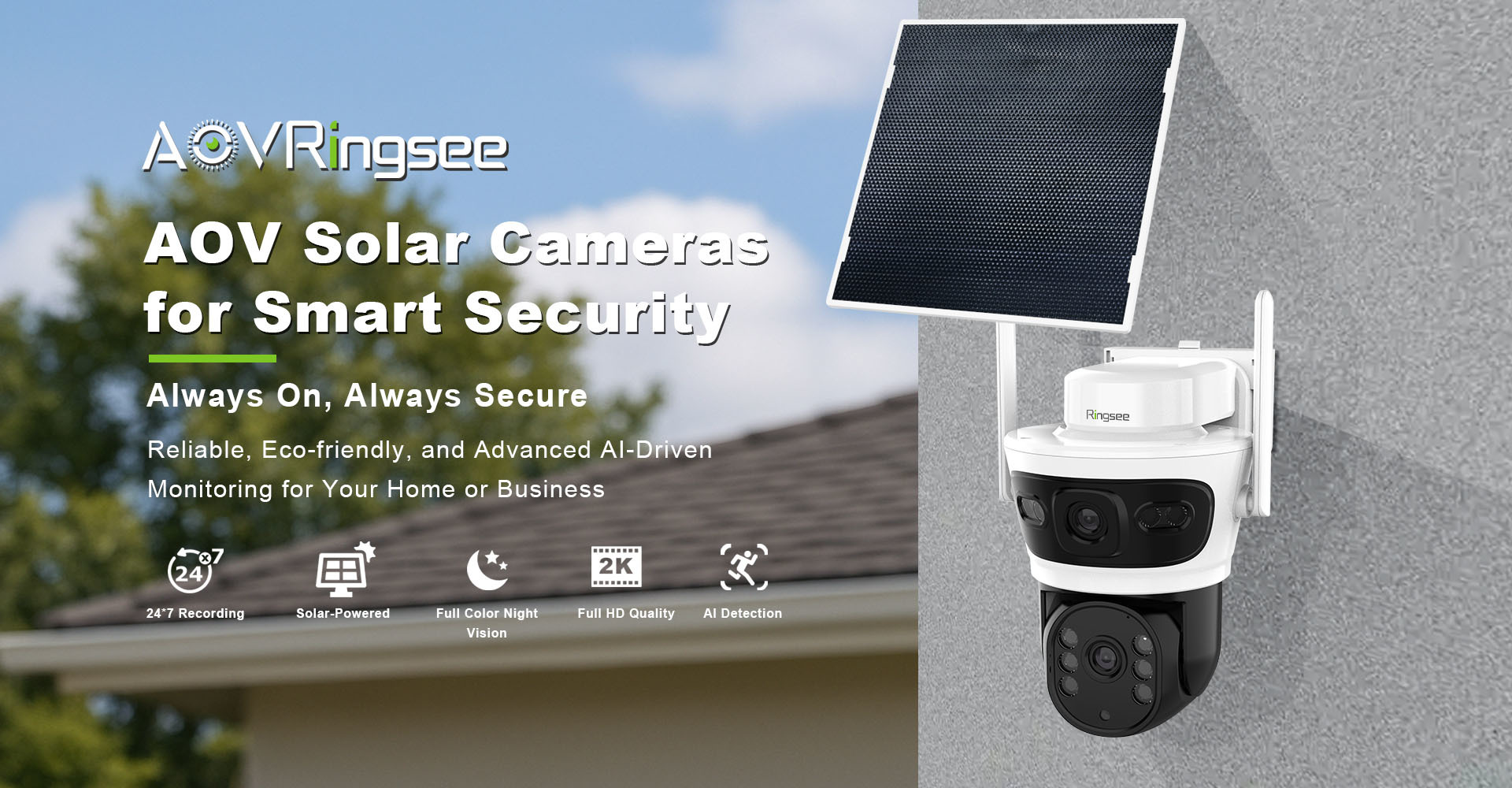
An AOV camera, short for Always-On Video camera, is engineered to continuously record video, either around the clock or during specific time periods. Unlike traditional motion detection cameras that only activate upon detecting movement, AOV cameras maintain an uninterrupted visual record. Most models include AI smart detection features capable of recognizing people, vehicles, or objects—minimizing false alarms and enabling real-time security monitoring.
Key Features of AOV Cameras:
Continuous video surveillance without missing any moment.
AI-based motion analysis for intelligent human and vehicle detection.
Typically powered by solar energy and rechargeable batteries, supporting 24/7 operation in remote locations.
Suited for high-security environments that demand full-time video surveillance.
These features make AOV cameras an excellent choice for users who need solar-powered surveillance cameras for locations like farms, construction sites, warehouses, or parking lots.
What Is a PIR (Passive Infrared) Camera?
A PIR security camera uses passive infrared sensors to detect motion by sensing heat emitted from living beings or moving objects. These battery-operated security cameras remain in a low-power sleep mode until motion is detected, at which point they wake up to record short video clips.
Key Features of PIR Cameras:
Motion-triggered recording, conserving power and storage.
Uses infrared heat detection to sense people, animals, or other heat sources.
Ideal for low-traffic areas where long standby time is more important than continuous video.
Highly efficient and compatible with battery-operated camera systems.
While effective, PIR technology can be prone to false alarms caused by sunlight, wind-blown plants, or small animals. However, for users prioritizing power efficiency, especially in outdoor battery security cameras, PIR remains a solid choice.
Key Differences Between AOV and PIR Security Cameras
| Feature | AOV Camera (Always-On Video) | PIR Camera (Passive Infrared) |
|---|---|---|
| Recording Mode | Continuous or scheduled | Motion-triggered only |
| Detection Method | AI-based smart detection | Infrared heat motion detection |
| Power Usage | Higher; solar + battery required | Low; ideal for battery-only setups |
| Video Coverage | Full-time monitoring; no gaps | Limited to event-based clips |
| False Alarms | Reduced with AI filtering | Higher due to heat-based triggers |
| Storage Needs | More storage required | Minimal storage consumption |
| Best Use Cases | High-security zones, remote viewing, 24/7 recording | Low-activity areas, power-saving needs |
Choosing the Right Security Camera for Your Needs
The best choice between an AOV surveillance camera and a PIR motion detection camera depends on your specific application:
Opt for an AOV camera if you need full-time, solar-powered video monitoring with smart detection features. These systems are perfect for large properties, business sites, or any location that benefits from continuous surveillance and AI-assisted video analytics.
Choose a PIR security camera if your priority is long battery life and power efficiency. Ideal for residential areas, vacation homes, or garages, these cameras offer a cost-effective solution for motion-activated video recording without the need for constant power supply.
Conclusion
Both Always-On Video cameras and PIR motion detection cameras serve essential roles in modern security systems. AOV models provide robust, intelligent surveillance with non-stop coverage, while PIR models offer practical, low-energy operation for selective recording. Understanding their differences will help you invest in the right security camera solution tailored to your environment and budget.
Prev:
Related News
Target readers: security owners, system integrators, and EHS engineers for petrochemical, oil and gas, pharmaceutical, powder processing, and coal mining sites where explosive gas or combustible dust exists. Core takeaway: a normal camera is itself an ignition source in flammable environments. You must use explosion proof cameras certified to ATEX, IECEx, or China Ex, selected by hazard zone, installed with proper grounding, and documented for compliance. This guide gives a reusable selection, install, and acceptance workflow.
Nov 08,2026
4G 5G Cellular Surveillance Camera Guide: Remote Video without Broadband
Target readers: security owners and integrators for farms, orchards, fisheries, construction, oil and mining sites, vehicle fleets, and remote African villages where broadband is scarce. Core takeaway: when there is no fiber, no broadband, and frequent power loss, a SIM card cellular camera is the easiest and most scalable remote video option. This guide gives a reusable architecture covering power, data, backhaul, AI, and compliant deployment.
Nov 08,2026
Analog CCTV Upgrade Guide: Coax HD Reuse vs Full IP Rebuild, Cost and Timeline Compared
Factory, campus and retail chains running analog surveillance for five or six years face the same wall: blurry images, unretrievable footage, and no path to AI analytics on legacy hardware. This guide breaks down pre-upgrade system inventory, compares the coax-HD reuse route against a full IP rebuild, gives bandwidth and storage recalculation formulas, and lays out a zoned, non-disruptive cutover plan with a selection checklist.
Oct 31,2026
CCTV Maintenance Outsourcing: SLA Tiers, Market Rates, KPI and Contract Playbook
Conclusion first: the real cost of a surveillance system is in its operation. Three years of maintenance typically equals 30% to 50% of the build cost, yet most buyers spend the budget at install and leave operation to whoever happens to notice. Lock the maintenance boundary while signing the build contract. This guide breaks down the in-house versus outsourced decision model, a three-tier SLA (P1 / P2 / P3), per-point market rates and how to read a quote, the two KPIs that decide payment (camera online rate and footage integrity), the five clauses every contract must hold, the 90-day handover that most often loses control, plus a selection checklist and acceptance tests.
Oct 25,2026
Links:One Belt Power Technology
Add: 14th Floor, Baoshan Building, Longhua District, Shenzhen China.
Privacy Policy | SEO | CitySite | Support: 300.cn Dongguan