














































































Best 4G Solar Security Cameras for Farms 2025 – OEM/ODM Outdoor Solutions from China Manufacturers
Publish:
2025-05-09 15:26
Source:
https://www.ring-see.com
With farm theft, trespassing, and property damage on the rise, reliable video surveillance is no longer a luxury—it’s a necessity. For large agricultural operations without access to power lines or Wi-Fi, 4G solar-powered cameras offer the ideal remote monitoring solution.
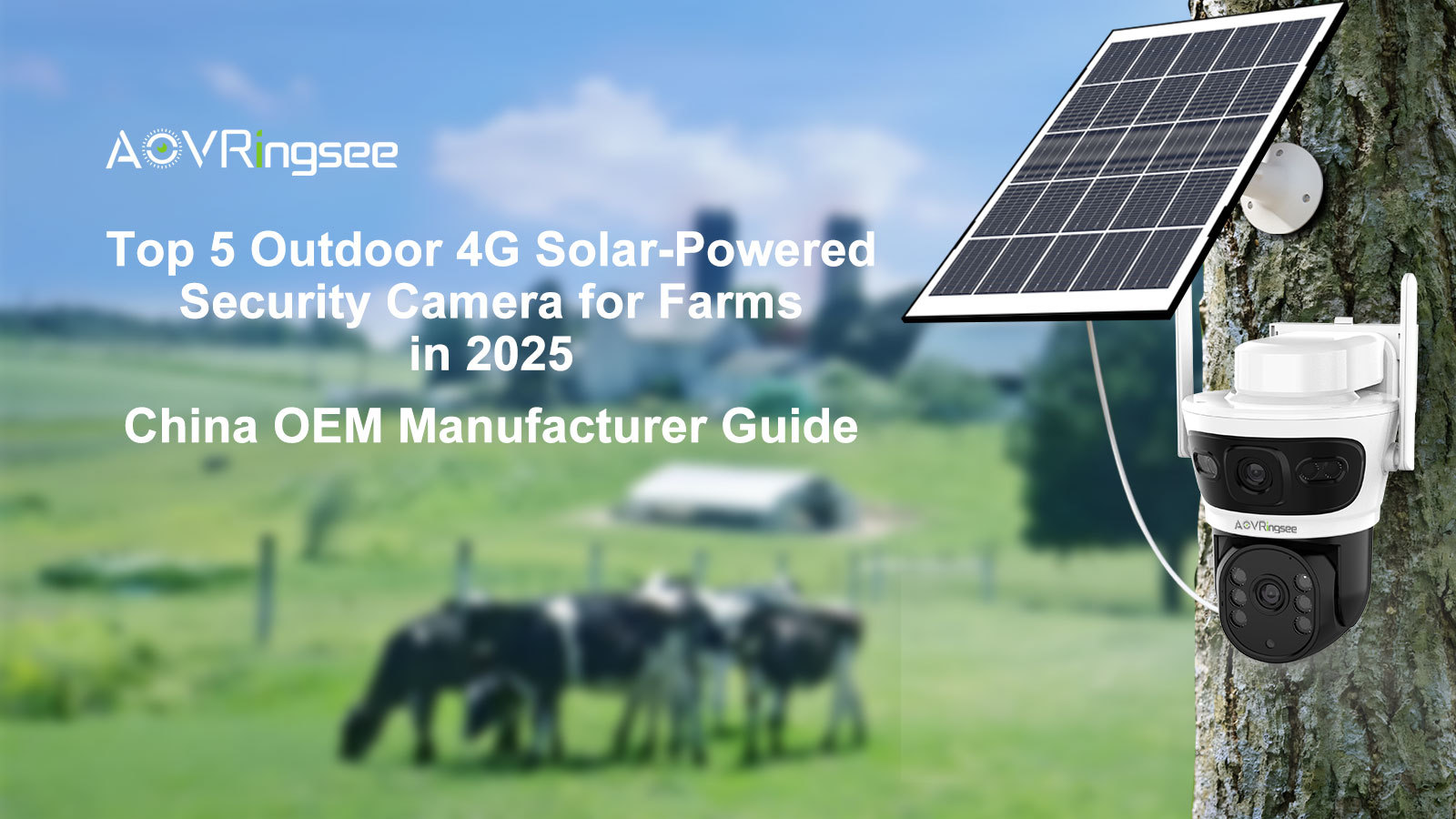
With farm theft, trespassing, and property damage on the rise, reliable video surveillance is no longer a luxury—it’s a necessity. For large agricultural operations without access to power lines or Wi-Fi, 4G solar-powered cameras offer the ideal remote monitoring solution. This guide provides an in-depth look at the top outdoor 4G solar security cameras for farms in 2025, based on real-world needs like power autonomy, mobile network compatibility, battery capacity, and durability in harsh outdoor environments.
Why Farmers Need Continuous 4G Surveillance
Farm environments pose unique security challenges:
No Wi-Fi or grid power in fields, barns, or livestock pens
Large areas to monitor, often with multiple access points
Extreme weather conditions (sun, dust, rain, cold)
Animal-triggered false alarms, which waste data and battery
A properly selected 4G solar camera solves these issues by offering:
Autonomous operation (solar + battery)
Live view and alerts over 4G LTE
AI-powered event detection to reduce false positives
Data-efficient video compression
Top Outdoor 4G Solar Security Cameras for Farms (2025)
Ringsee RS-SOC-9110 – Best for Wide Area AI Monitoring
Camera System: Triple-lens, 4MP total resolution
Detection: Smart AI for human/vehicle classification
Battery: 12,000mAh with a 6W high-efficiency solar panel
Durability: IP66, with wide operating temperature range
Data Optimization: H.265 compression + SD/local storage + push alerts only
Why It’s Ideal: The RS-SOC-9110 from Ringsee provides extensive coverage (180°+ view) with a triple-lens setup. Built for farm owners needing fewer units to monitor large pastures or equipment yards. The AI engine filters out motion from animals, minimizing data drain and false notifications.
Selection Criteria: What Really Matters for Farm-Grade Cameras
Before investing, evaluate based on the following technical parameters:
1. Motion Detection Accuracy
AI Human/Vehicle Recognition: Reduces false triggers from pets, cows, or trees.
PIR Sensitivity Tuning: Should support distance and temperature calibration for open environments.
2. Battery + Solar Panel Sizing
Battery Capacity: At least 10,000mAh is recommended for cloudy days or winter conditions.
Solar Panel Wattage: Minimum of 3–5W required for consistent charging in medium to low sunlight.
MPPT Controller: Look for models with smart solar charging chips for energy efficiency.
3. 4G Signal Strength and SIM Compatibility
Must support multi-band LTE (B2/B4/B12/B13/B20) for rural coverage.
External antenna support is crucial in signal-degraded areas.
Works best with SIM cards from AT&T, T-Mobile, or regional LTE providers.
4. Build Quality and Environmental Durability
Ingress Protection (IP66 or higher) ensures resistance to rain, dust, and snow.
Cameras should operate in -20°C to 60°C for farm environments.
UV-resistant housing prolongs lifespan in direct sun.
Installation Tips for Open Farm Layouts
Unlike home setups, farms have few mounting structures and can experience harsh physical conditions. Consider these deployment strategies:
Mounting Poles: Use galvanized steel or pressure-treated wood poles at least 10 ft tall for broad visibility.
Orientation: South-facing solar panel tilt (~30–40°) maximizes charging.
Multi-Cam Sync: For large areas, position cameras 200–300ft apart and use app-based control to monitor all zones.
Test Signal First: Use a mobile phone or LTE tester to check reception before final mounting.
Protection: Consider mesh guards or casing to prevent damage by animals.
SIM Card Compatibility and Mobile Data Management
SIM Setup Checklist:
Unlocked 4G LTE Nano SIM card
Choose providers with rural bands (B12/B13/B20) depending on your location
Monthly data plans around 1–5GB are sufficient for motion-only alerts and low-frequency live viewing
Data-Saving Configuration:
Use H.265 video encoding for 40–50% data savings vs. H.264
Adjust alert sensitivity and zones to trigger only on key entrances or pathways
Use local SD storage for continuous recording while only uploading alert clips
Final Thoughts
For 2025, farmers seeking secure, power-independent, and low-maintenance video monitoring solutions will find 4G solar-powered cameras indispensable. Among the options, Ringsee RS-SOC-9110 stands out as a technically advanced choice for demanding rural environments—delivering smart AI filtering, long-term battery autonomy, and panoramic coverage with minimal cellular data use.
Related News
Target readers: security owners, system integrators, and EHS engineers for petrochemical, oil and gas, pharmaceutical, powder processing, and coal mining sites where explosive gas or combustible dust exists. Core takeaway: a normal camera is itself an ignition source in flammable environments. You must use explosion proof cameras certified to ATEX, IECEx, or China Ex, selected by hazard zone, installed with proper grounding, and documented for compliance. This guide gives a reusable selection, install, and acceptance workflow.
Nov 08,2026
4G 5G Cellular Surveillance Camera Guide: Remote Video without Broadband
Target readers: security owners and integrators for farms, orchards, fisheries, construction, oil and mining sites, vehicle fleets, and remote African villages where broadband is scarce. Core takeaway: when there is no fiber, no broadband, and frequent power loss, a SIM card cellular camera is the easiest and most scalable remote video option. This guide gives a reusable architecture covering power, data, backhaul, AI, and compliant deployment.
Nov 08,2026
Analog CCTV Upgrade Guide: Coax HD Reuse vs Full IP Rebuild, Cost and Timeline Compared
Factory, campus and retail chains running analog surveillance for five or six years face the same wall: blurry images, unretrievable footage, and no path to AI analytics on legacy hardware. This guide breaks down pre-upgrade system inventory, compares the coax-HD reuse route against a full IP rebuild, gives bandwidth and storage recalculation formulas, and lays out a zoned, non-disruptive cutover plan with a selection checklist.
Oct 31,2026
CCTV Maintenance Outsourcing: SLA Tiers, Market Rates, KPI and Contract Playbook
Conclusion first: the real cost of a surveillance system is in its operation. Three years of maintenance typically equals 30% to 50% of the build cost, yet most buyers spend the budget at install and leave operation to whoever happens to notice. Lock the maintenance boundary while signing the build contract. This guide breaks down the in-house versus outsourced decision model, a three-tier SLA (P1 / P2 / P3), per-point market rates and how to read a quote, the two KPIs that decide payment (camera online rate and footage integrity), the five clauses every contract must hold, the 90-day handover that most often loses control, plus a selection checklist and acceptance tests.
Oct 25,2026
Links:One Belt Power Technology
Add: 14th Floor, Baoshan Building, Longhua District, Shenzhen China.
Privacy Policy | SEO | CitySite | Support: 300.cn Dongguan