














































































Use Security Cameras Without WiFi or Electricity | Ringsee™
Publish:
2025-05-10 10:17
Source:
https://www.ring-see.com
These advanced surveillance devices are specifically designed for off-grid use, offering powerful monitoring without relying on traditional power sources or internet connections. Leading security camera manufacturers, like Ringsee, now offer flexible OEM/ODM services for businesses looking to customize or brand their own off-grid solutions.
In today’s world, security is essential—whether you're safeguarding a remote cabin, monitoring your farm, or keeping an eye on a construction site. But what happens when your location has no WiFi and no access to electricity? The good news is: you can still use a security camera without WiFi or power. The solution? A 4G solar camera.
These advanced surveillance devices are specifically designed for off-grid use, offering powerful monitoring without relying on traditional power sources or internet connections. Leading security camera manufacturers, like Ringsee, now offer flexible OEM/ODM services for businesses looking to customize or brand their own off-grid solutions.
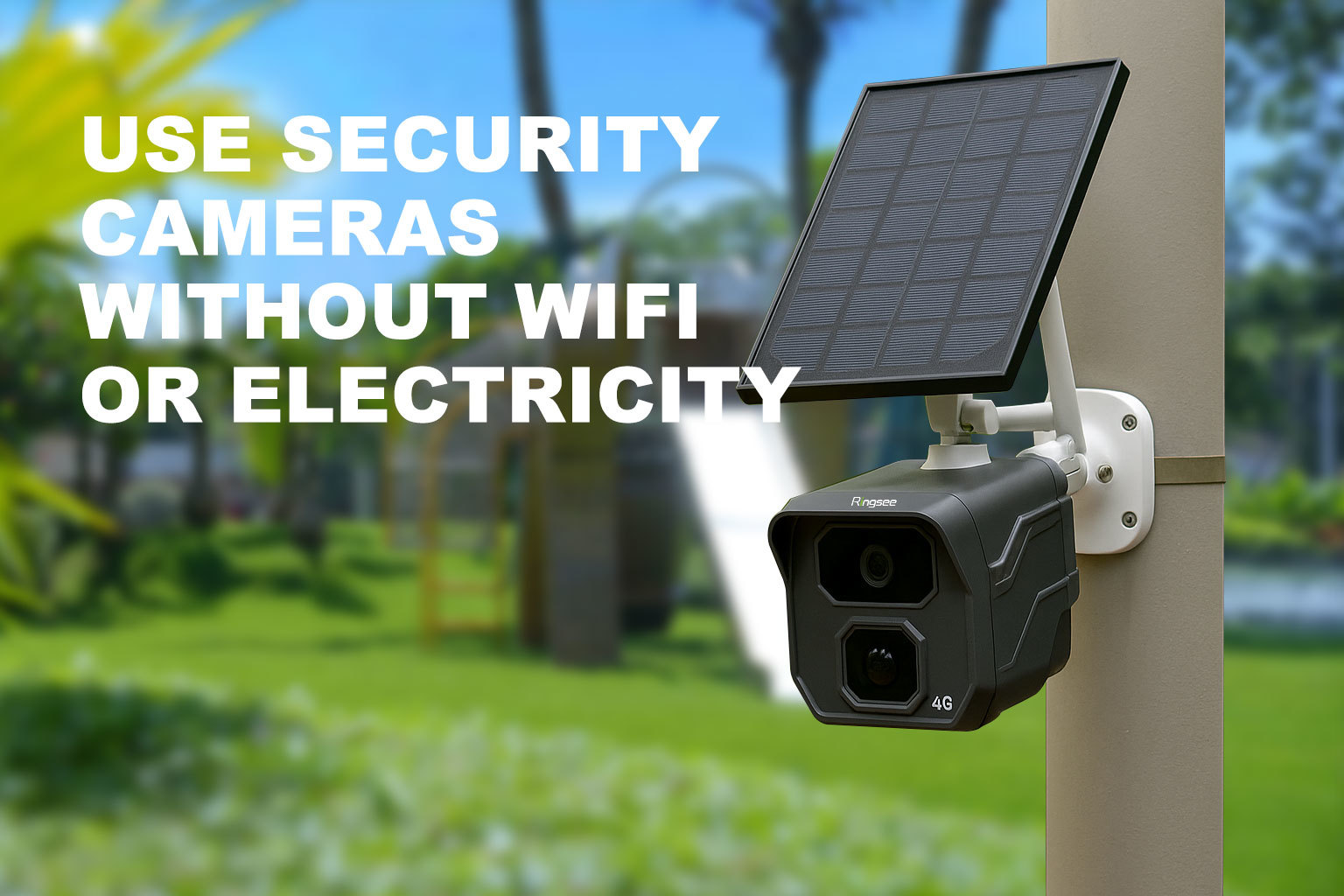
What Makes a 4G Solar Camera Ideal for Off-Grid Use
Unlike standard IP cameras that depend on home WiFi networks and wall power, a 4G solar camera uses a cellular network and solar energy to operate. This makes it an ideal solution for:
Remote areas without internet infrastructure
Outdoor locations with limited access to electricity
Temporary or mobile security setups
By inserting a 4G SIM card, the camera connects to a mobile network, allowing real-time remote access and alerts. Solar panels and rechargeable batteries provide a sustainable and uninterrupted power source. For businesses, working with an experienced solar camera OEM supplier can ensure these features are tailored to meet specific industry or geographic needs.
Battery, Solar Panel, and 4G SIM: How It All Works
A 4G solar security camera typically comes with three main components working together:
Battery
A built-in rechargeable lithium battery powers the camera during nighttime or cloudy days. This ensures 24/7 operation, even without direct sunlight.
Solar Panel
Mounted solar panels charge the internal battery during the day. Some models, like the Ringsee AOV 4G solar camera, feature high-efficiency panels ideal for low-light regions.
4G SIM Card
Instead of using WiFi, the camera connects to the cloud via 4G LTE. All you need is a data-enabled SIM card, and you can stream footage, receive alerts, and manage settings remotely. As an ODM manufacturer, Ringsee also offers flexibility for global network compatibility and localized firmware customization.
Best Locations for This Setup (Forests, Campsites, Boats)
A 4G solar-powered camera is versatile and reliable in a wide range of environments. Here are some ideal use cases:
Forests or nature reserves – Monitor wildlife or prevent illegal activities in remote areas.
Campsites – Keep your gear and surroundings safe during overnight trips.
Boats and marinas – Watch your property even while docked in isolated waters.
Farms, barns, or ranches – Protect agricultural assets without running electrical lines.
Construction sites – Ideal for temporary or mobile job sites without network infrastructure.
Security camera OEM factories often customize camera housings, storage configurations, and battery capacities based on where these units will be deployed.
Features to Prioritize for Off-Grid Monitoring
Not all cameras are built equally. When selecting a 4G solar camera, look for the following features:
AI motion detection for real-time alerts without false alarms
Full-color night vision to monitor clearly after dark
IP66+ waterproof rating for extreme outdoor conditions
Remote viewing and playback via a mobile app
Two-way audio for communication and deterrence
Expandable storage via microSD or cloud backup
Ringsee’s low-power solar cameras, available for OEM bulk supply, include these advanced technologies. As a trusted manufacturer of solar security cameras, Ringsee ensures each product meets international quality standards, ideal for brand owners and distributors.
How to Check and Monitor Footage Remotely
One of the major advantages of a 4G solar camera is the ability to stay connected from anywhere. Here's how you can monitor remotely:
Install a SIM card with a data plan compatible with the camera (check network support in your country).
Download the companion mobile app (often provided by the camera manufacturer).
Scan the QR code or follow the pairing steps to link your camera.
Access real-time video, playback recordings, and receive motion alerts via the app.
Adjust settings remotely, such as sensitivity, alert zones, or notification preferences.
These features make the product not just reliable, but also scalable—an essential consideration for distributors, project integrators, and OEM clients managing multiple units across different regions.
Conclusion:
If you need security in places where WiFi and electricity are unavailable, a 4G solar security camera is your best bet. With smart features, sustainable power, and remote access, it's the perfect tool for modern off-grid surveillance. Whether it's a remote farm or an isolated boat, Ringsee’s 4G solar cameras—backed by years of experience as a security camera OEM/ODM manufacturer—provide reliable, autonomous protection anywhere.
Related News
Target readers: security owners, system integrators, and EHS engineers for petrochemical, oil and gas, pharmaceutical, powder processing, and coal mining sites where explosive gas or combustible dust exists. Core takeaway: a normal camera is itself an ignition source in flammable environments. You must use explosion proof cameras certified to ATEX, IECEx, or China Ex, selected by hazard zone, installed with proper grounding, and documented for compliance. This guide gives a reusable selection, install, and acceptance workflow.
Nov 08,2026
4G 5G Cellular Surveillance Camera Guide: Remote Video without Broadband
Target readers: security owners and integrators for farms, orchards, fisheries, construction, oil and mining sites, vehicle fleets, and remote African villages where broadband is scarce. Core takeaway: when there is no fiber, no broadband, and frequent power loss, a SIM card cellular camera is the easiest and most scalable remote video option. This guide gives a reusable architecture covering power, data, backhaul, AI, and compliant deployment.
Nov 08,2026
Analog CCTV Upgrade Guide: Coax HD Reuse vs Full IP Rebuild, Cost and Timeline Compared
Factory, campus and retail chains running analog surveillance for five or six years face the same wall: blurry images, unretrievable footage, and no path to AI analytics on legacy hardware. This guide breaks down pre-upgrade system inventory, compares the coax-HD reuse route against a full IP rebuild, gives bandwidth and storage recalculation formulas, and lays out a zoned, non-disruptive cutover plan with a selection checklist.
Oct 31,2026
CCTV Maintenance Outsourcing: SLA Tiers, Market Rates, KPI and Contract Playbook
Conclusion first: the real cost of a surveillance system is in its operation. Three years of maintenance typically equals 30% to 50% of the build cost, yet most buyers spend the budget at install and leave operation to whoever happens to notice. Lock the maintenance boundary while signing the build contract. This guide breaks down the in-house versus outsourced decision model, a three-tier SLA (P1 / P2 / P3), per-point market rates and how to read a quote, the two KPIs that decide payment (camera online rate and footage integrity), the five clauses every contract must hold, the 90-day handover that most often loses control, plus a selection checklist and acceptance tests.
Oct 25,2026
Links:One Belt Power Technology
Add: 14th Floor, Baoshan Building, Longhua District, Shenzhen China.
Privacy Policy | SEO | CitySite | Support: 300.cn Dongguan