














































































Six major differences between surveillance cameras&security cameras
Publish:
2024-11-27 15:03
Source:
https://www.ring-see.com
Ringsee-Surveillance cameras and security cameras are essential tools in modern security systems, but they differ significantly in purpose, functionality, and application.
Surveillance cameras and security cameras are essential tools in modern security systems, but they differ significantly in purpose, functionality, and application. Understanding the distinctions between these two types of cameras is crucial for selecting the right equipment to meet specific security needs.
Surveillance cameras
Primarily designed for ongoing monitoring and recording activities. These cameras are often connected to a centralized system and are used to observe large areas, such as public spaces, commercial properties, or industrial facilities. Surveillance systems are typically monitored either in real-time by security personnel or reviewed later through recorded footage. Their primary goal is to provide comprehensive coverage, assist in incident investigations, and deter criminal activity by creating a perception of being watched. These cameras are frequently integrated into closed-circuit television (CCTV) systems, offering live feeds to monitoring stations or control rooms.
Security cameras
Focused on actively protecting specific areas or assets. These cameras are often part of a broader security system that includes alarms, access controls, and sensors. Unlike surveillance cameras, security cameras may include features designed to respond immediately to threats, such as motion detection, facial recognition, or integration with alarms. Security cameras are often used in private properties, small businesses, and homes to monitor entry points, detect unauthorized access, or trigger alerts in case of suspicious activity.
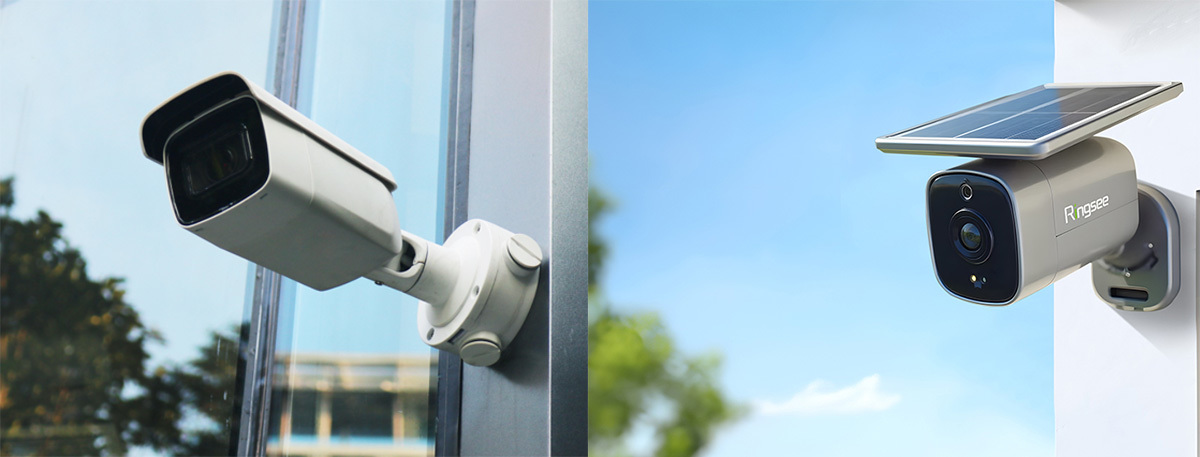
| Security cameras | Surveillance cameras | |
| Purpose and Focus | Primarily designed for deterrence and recording. Often visible to discourage unauthorized activity or intrusions. Used to monitor specific areas (e.g., entrances, offices). Typically paired with alarms or access control systems. |
Focus on long-term monitoring and data collection. Often covert or less noticeable to avoid detection. Used for continuous observation and evidence gathering. Deployed in public spaces or large areas to track ongoing activities. |
| Connectivity and Operation | Typically connected to a closed system, such as a DVR (Digital Video Recorder) or NVR (Network Video Recorder). Real-time monitoring is common, but recording is often event-triggered (e.g., motion detection). May integrate with smart systems for remote alerts or real-time notifications through apps. |
Often part of larger, centralized systems like a CCTV (Closed-Circuit Television) network. Operate continuously and are monitored in real-time by security personnel. May be connected to advanced software for facial recognition, object detection, or behavioral analytics. |
| Visibility and Design | Typically visible and sometimes equipped with flashing lights or signs to warn intruders. Designed to deter criminal activities proactively. |
Discreet or concealed to monitor without being noticed. Focus on observing behaviors without alerting subjects. |
| Deployment Areas | Commonly used in private spaces like homes, small businesses, parking lots, and offices. Focused on entry points, valuables, or areas prone to security breaches. |
Often deployed in large-scale public areas such as streets, airports, stadiums, and government buildings. Cover wide zones for monitoring and public safety. |
| Features | Motion detection, night vision, two-way audio, and integration with smart home systems are common. Focused on immediate security measures like triggering alarms or capturing evidence of specific events. |
Equipped with high-resolution capabilities, panoramic views, and advanced analytics for long-term data collection. May include sophisticated software for identifying patterns or individuals over time. |
| Users | Often used by individuals, small businesses, or organizations for localized security needs. | Typically operated by governments, law enforcement, or large organizations for broader security objectives. |
| Key Takeaway | Security cameras are a proactive deterrent focusing on immediate protection and visibility. | Surveillance cameras are primarily used for ongoing monitoring, evidence gathering, and analytics, often covertly. |
In summary, surveillance cameras are designed for ongoing observation and broad situational awareness, while security cameras are tailored for proactive protection and immediate response. Both play distinct but complementary roles in enhancing safety and security across various environments.
Related News
Target readers: security owners, system integrators, and EHS engineers for petrochemical, oil and gas, pharmaceutical, powder processing, and coal mining sites where explosive gas or combustible dust exists. Core takeaway: a normal camera is itself an ignition source in flammable environments. You must use explosion proof cameras certified to ATEX, IECEx, or China Ex, selected by hazard zone, installed with proper grounding, and documented for compliance. This guide gives a reusable selection, install, and acceptance workflow.
Nov 08,2026
4G 5G Cellular Surveillance Camera Guide: Remote Video without Broadband
Target readers: security owners and integrators for farms, orchards, fisheries, construction, oil and mining sites, vehicle fleets, and remote African villages where broadband is scarce. Core takeaway: when there is no fiber, no broadband, and frequent power loss, a SIM card cellular camera is the easiest and most scalable remote video option. This guide gives a reusable architecture covering power, data, backhaul, AI, and compliant deployment.
Nov 08,2026
Analog CCTV Upgrade Guide: Coax HD Reuse vs Full IP Rebuild, Cost and Timeline Compared
Factory, campus and retail chains running analog surveillance for five or six years face the same wall: blurry images, unretrievable footage, and no path to AI analytics on legacy hardware. This guide breaks down pre-upgrade system inventory, compares the coax-HD reuse route against a full IP rebuild, gives bandwidth and storage recalculation formulas, and lays out a zoned, non-disruptive cutover plan with a selection checklist.
Oct 31,2026
CCTV Maintenance Outsourcing: SLA Tiers, Market Rates, KPI and Contract Playbook
Conclusion first: the real cost of a surveillance system is in its operation. Three years of maintenance typically equals 30% to 50% of the build cost, yet most buyers spend the budget at install and leave operation to whoever happens to notice. Lock the maintenance boundary while signing the build contract. This guide breaks down the in-house versus outsourced decision model, a three-tier SLA (P1 / P2 / P3), per-point market rates and how to read a quote, the two KPIs that decide payment (camera online rate and footage integrity), the five clauses every contract must hold, the 90-day handover that most often loses control, plus a selection checklist and acceptance tests.
Oct 25,2026
Links:One Belt Power Technology
Add: 14th Floor, Baoshan Building, Longhua District, Shenzhen China.
Privacy Policy | SEO | CitySite | Support: 300.cn Dongguan