














































































The Benefits and Limitations of Solar-Powered Security Cameras: A Comprehensive Guide
Publish:
2025-01-11 11:06
Source:
https://www.ring-see.com
As the demand for sustainable and efficient security solutions grows, solar-powered cameras have become a preferred choice for homeowners and businesses alike.
As the demand for sustainable and efficient security solutions grows, solar-powered cameras have become a preferred choice for homeowners and businesses alike. These low-power, eco-friendly devices not only offer an effective way to monitor properties but also reduce reliance on conventional power sources. In this article, we’ll explore the advantages and disadvantages of solar-powered security cameras, helping you make an informed decision for your security needs.
How Long Do Solar-Powered Cameras Last?
The lifespan of solar-powered security cameras typically ranges from 2 to 5 years. Several factors influence this duration, such as:
Battery Type and Quality: Most solar cameras use lithium-ion batteries, which degrade over time due to usage and environmental conditions.
Sunlight Exposure: The more direct sunlight the camera receives, the better the battery will stay charged, extending the camera’s overall lifespan.
Climate: Extreme temperatures, whether hot or cold, can negatively impact battery performance and longevity.
With regular maintenance, like cleaning the solar panel and monitoring battery health, low-power solar cameras can provide reliable security for several years. However, users should expect to replace the battery after this period to maintain optimal functionality.
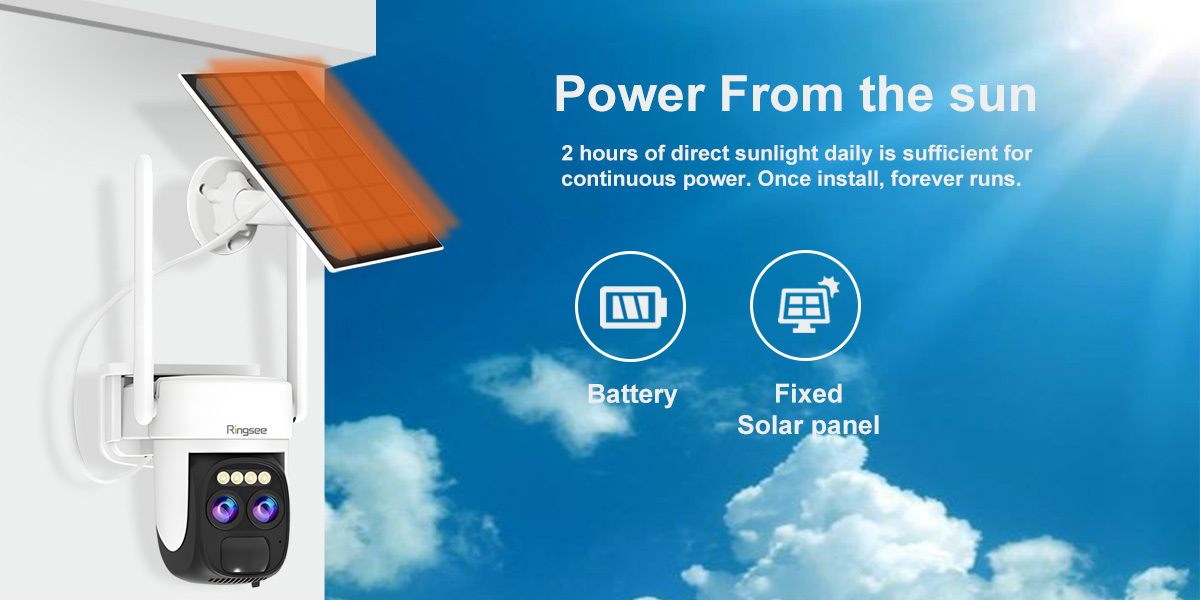
Advantages of Solar-Powered Security Cameras
Energy Independence:
One of the primary benefits of solar-powered security cameras is their energy efficiency. These cameras operate wirelessly, drawing power directly from solar energy. This not only eliminates the need for complex wiring installations but also makes these systems self-sustaining. As long as there’s enough sunlight, the cameras can continue to operate without any additional energy costs, making them an ideal choice for low-power applications.
Sustainability and Eco-Friendliness:
Solar-powered cameras rely on renewable energy, contributing to the reduction of your carbon footprint. By harnessing the power of the sun, these solar cameras help minimize reliance on non-renewable resources, making them a great choice for environmentally conscious individuals and businesses. Many manufacturers of solar-powered security cameras are focusing on eco-friendly solutions, ensuring that their products are both effective and sustainable.
Minimal Maintenance:
Solar-powered cameras are designed for long-term operation with minimal intervention. Unlike traditional security cameras that may require regular battery replacements or constant connection to a power source, solar cameras are self-charging. The solar panels continually recharge the batteries, ensuring the camera remains operational with only occasional cleaning needed to remove dirt and debris from the panels.
Ideal for Remote Locations:
Solar-powered cameras are perfect for remote or off-grid locations. They don’t need to be near a power outlet, which makes them ideal for properties in rural areas, large estates, construction sites, or outdoor environments where electrical wiring is not practical. These low-power cameras can easily be placed in hard-to-reach areas, providing flexibility in monitoring various locations. Many suppliers offer solar cameras specifically designed for such applications, ensuring optimal performance in challenging environments.
Continuous Power Supply:
When installed correctly, solar panels keep the battery charged throughout the year, ensuring that the camera operates continuously. This continuous power allows for consistent surveillance without worrying about frequent battery charging or replacement. For manufacturers of solar-powered security cameras, providing reliable, low-power solutions is a key focus to meet the growing demand for uninterrupted monitoring.
Disadvantages of Solar-Powered Security Cameras
Sunlight Dependency:
The performance of solar-powered cameras is inherently tied to the availability of sunlight. In regions with frequent cloud cover, low sunlight during winter months, or overcast conditions, the camera may not charge effectively, leading to reduced battery life or gaps in surveillance coverage. Without enough sunlight, the camera may require additional charging or have limited functionality during certain seasons. This is a critical consideration when choosing a solar camera for your needs.
Higher Upfront Cost:
While solar-powered security cameras can save on electricity costs over time, they tend to come with a higher initial price compared to traditional wired or battery-operated cameras. The cost of the solar panels, integrated batteries, and advanced features can make the initial investment higher. However, these upfront costs can be offset by savings on energy bills and reduced maintenance costs over time.
Battery Degradation:
Like all rechargeable batteries, the battery life of solar-powered cameras will degrade after a few years of use. Over time, the battery’s ability to hold a charge diminishes, especially if the camera is frequently exposed to extreme temperatures or placed in an area with limited sunlight. This degradation may require battery replacement to keep the camera functioning at its best.
Limited Features and Performance:
Some solar-powered cameras may not support the high-definition video quality, continuous recording, or high bandwidth capabilities of wired systems. The camera’s performance can be limited by the energy available from the solar panel and battery, meaning users may need to compromise on certain features. For example, continuous recording may not be feasible in some low-power solar cameras due to energy constraints.
Aesthetic Considerations:
Solar panels, although essential for the operation of these cameras, can sometimes be seen as an eyesore, especially if placed in prominent locations. Some users may find it challenging to integrate solar-powered cameras into their home or business’s overall aesthetic design, as the solar panel can stand out or detract from the visual appeal of the property.
Obstructions and Placement Challenges:
To work efficiently, solar-powered cameras need unobstructed access to sunlight. Obstructions such as trees, tall buildings, or other structures can block sunlight from reaching the solar panel, reducing the camera’s charging efficiency. In these cases, you may need to adjust the placement of the camera or panel to ensure it receives adequate sunlight.

Solar-powered security cameras are an excellent choice for those looking for a sustainable, energy-efficient, and low-maintenance security solution. They offer unique advantages, such as reduced energy costs, flexibility in placement, and a minimal environmental impact. However, potential buyers should also be aware of the challenges, including performance dependency on sunlight, higher initial costs, and the need for proper maintenance to ensure optimal function.
If you live in an area with adequate sunlight and are seeking a flexible and sustainable security solution, solar-powered cameras could be the perfect addition to your security infrastructure. Many leading manufacturers and suppliers are continuously improving their solar camera technologies to offer better performance, extended battery life, and more advanced features, making them a viable choice for various security needs.
Related News
Target readers: security owners, system integrators, and EHS engineers for petrochemical, oil and gas, pharmaceutical, powder processing, and coal mining sites where explosive gas or combustible dust exists. Core takeaway: a normal camera is itself an ignition source in flammable environments. You must use explosion proof cameras certified to ATEX, IECEx, or China Ex, selected by hazard zone, installed with proper grounding, and documented for compliance. This guide gives a reusable selection, install, and acceptance workflow.
Nov 08,2026
4G 5G Cellular Surveillance Camera Guide: Remote Video without Broadband
Target readers: security owners and integrators for farms, orchards, fisheries, construction, oil and mining sites, vehicle fleets, and remote African villages where broadband is scarce. Core takeaway: when there is no fiber, no broadband, and frequent power loss, a SIM card cellular camera is the easiest and most scalable remote video option. This guide gives a reusable architecture covering power, data, backhaul, AI, and compliant deployment.
Nov 08,2026
Analog CCTV Upgrade Guide: Coax HD Reuse vs Full IP Rebuild, Cost and Timeline Compared
Factory, campus and retail chains running analog surveillance for five or six years face the same wall: blurry images, unretrievable footage, and no path to AI analytics on legacy hardware. This guide breaks down pre-upgrade system inventory, compares the coax-HD reuse route against a full IP rebuild, gives bandwidth and storage recalculation formulas, and lays out a zoned, non-disruptive cutover plan with a selection checklist.
Oct 31,2026
CCTV Maintenance Outsourcing: SLA Tiers, Market Rates, KPI and Contract Playbook
Conclusion first: the real cost of a surveillance system is in its operation. Three years of maintenance typically equals 30% to 50% of the build cost, yet most buyers spend the budget at install and leave operation to whoever happens to notice. Lock the maintenance boundary while signing the build contract. This guide breaks down the in-house versus outsourced decision model, a three-tier SLA (P1 / P2 / P3), per-point market rates and how to read a quote, the two KPIs that decide payment (camera online rate and footage integrity), the five clauses every contract must hold, the 90-day handover that most often loses control, plus a selection checklist and acceptance tests.
Oct 25,2026
Links:One Belt Power Technology
Add: 14th Floor, Baoshan Building, Longhua District, Shenzhen China.
Privacy Policy | SEO | CitySite | Support: 300.cn Dongguan