














































































Why Sensor Quality Matters More Than Megapixels in Security Cameras: What You Really Need to Know
Publish:
2026-03-08 12:32
Source:
https://www.ring-see.com
Don’t be fooled by megapixel numbers. Learn why sensor quality, pixel size, dynamic range, and ISP tuning are the real factors that determine day/night performance and AI accuracy for security cameras. Practical buying checklist included.
When shopping for security cameras, many buyers chase big numbers — “5MP,” “4K,” or higher — assuming more megapixels equals better footage. The reality is different: sensor quality and pixel size determine how well a camera performs in real-world conditions (especially at night), how reliable AI detection is, and whether you’ll actually be able to identify faces or license plates from recorded footage.
This rewritten article explains what to look for, why sensor choice matters more than raw pixel count, and gives a practical buyer checklist you can use when comparing cameras.
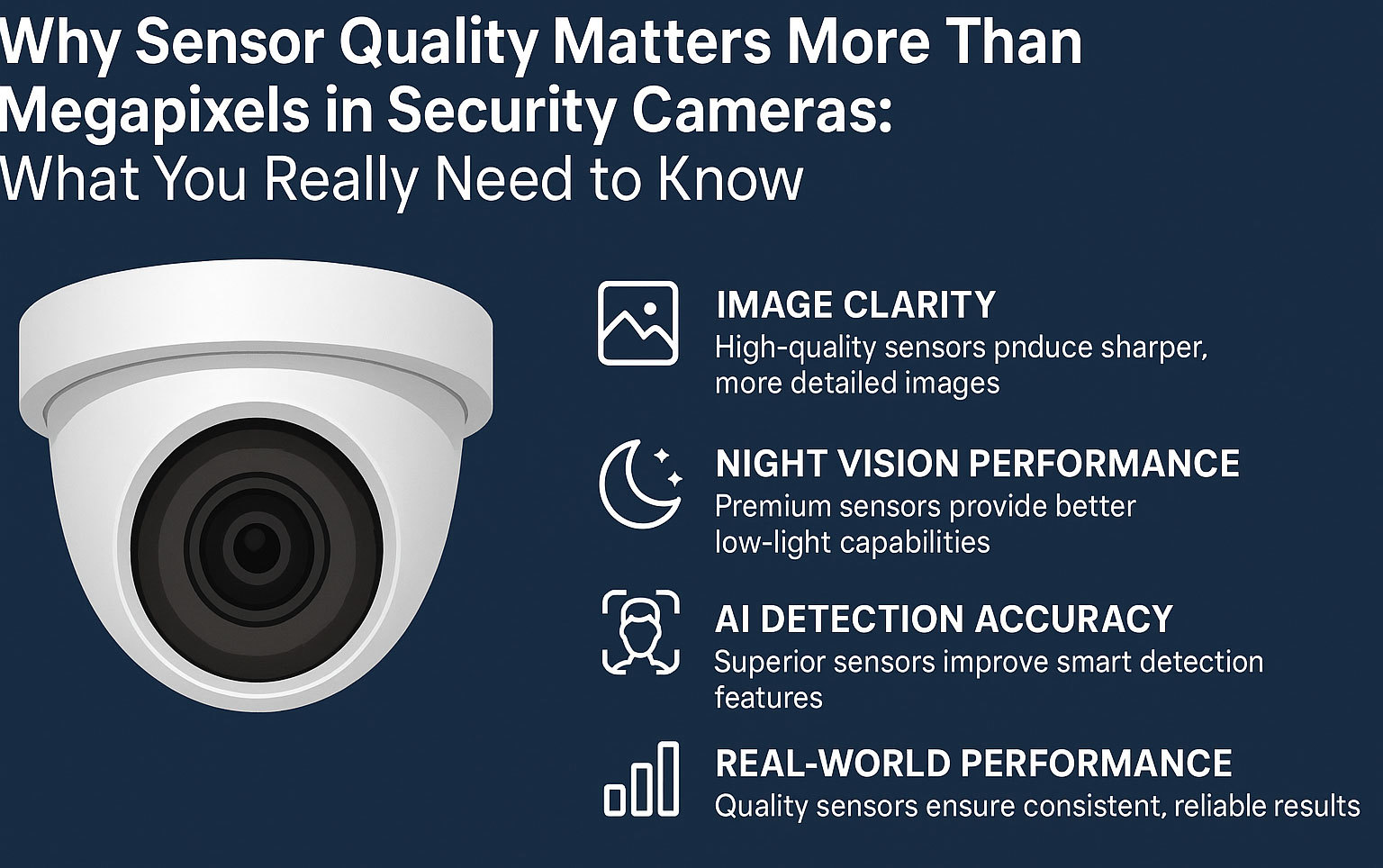
Why megapixels alone don’t guarantee better footage
Pixels are only part of the story. Higher resolution increases detail only if each pixel receives enough light. Cheap sensors pack many small pixels that struggle in dim scenes, producing noisy or soft images.
Pixel size matters. Larger pixels capture more photons, improving brightness and reducing noise. A well-balanced sensor can deliver clearer images at 2MP or 5MP than a poor-quality sensor at a higher resolution.
Pixel size, light sensitivity, and practical impact
Larger pixels → better light sensitivity → cleaner low-light images and improved color.
Sensor engineering (microlenses, back-illumination) further boosts how efficiently pixels gather light.
In practical terms: a 4MP camera with a quality sensor often gives better night images than an 8MP camera with a low-end sensor.
Low-light performance and night vision: the real differentiators
Premium sensors are designed for surveillance environments where lighting changes constantly. Sensors built with advanced back-illumination and larger pixel architectures deliver:
higher infrared (IR) sensitivity,
lower digital noise,
clearer, more usable night-time images.
Manufacturers such as Sony and OmniVision produce sensor families optimized for low-light surveillance — but it’s the camera maker’s implementation (lens, ISP tuning, and IR design) that ultimately determines performance.
Real-World Comparison
| Feature | Low-End Sensor | High-End Sensor |
|---|---|---|
| Daylight Image | Acceptable, flat | Sharp, vibrant, detailed |
| Night Image | Noisy, unclear | Bright, low-noise, high contrast |
| Motion Detection | Inconsistent | Accurate, responsive |
| AI Recognition | Struggles with faces or shapes | Clear object classification |
| Dynamic Range | Poor highlight/shadow control | Balanced and natural |
Dynamic range and color accuracy — why they matter in security
A sensor’s dynamic range determines its ability to retain detail in both shadow and highlight areas. Good dynamic range prevents blown-out windows or lost shadow detail when a scene contains both sunlight and shade. Accurate color reproduction helps AI and human operators distinguish objects and clothing correctly, which improves identification and fewer false alarms.
Sensors and AI features: better input → better detection
AI modules (motion, human/vehicle classification, face detection) depend on clean, detailed images:
Superior sensors provide crisper edges and truer colors, which improves algorithm accuracy.
Poor sensors cause noisy input that increases false positives/negatives and reduces reliability.
How to choose a camera — practical checklist
Start with sensor specs, not only resolution. Look for pixel size (µm), sensor family (back-illuminated, STARVIS-type design), and dynamic range values if available.
Evaluate lens quality. A sharp, well-matched lens is as important as the sensor itself.
Check manufacturer tuning. Read sample night/day images and real-world demos — ISP tuning and IR design make a big difference.
Consider AI needs. If you rely on person/vehicle alerts or face capture, prioritize sensors and cameras marketed with proven AI accuracy and real examples.
Test low-light samples. Request sample footage (day/night) or look for independent reviews showing the camera in real scenes.
Balance resolution and pixel size. For many installations, 2–5MP with a high-quality sensor is the practical sweet spot.
Account for installation environment. Indoor, outdoor, high-contrast scenes, and long distances all influence the best sensor/lens choice.
Quick guide
Budget cameras (focus on megapixel marketing): Often high pixel count but small pixel size → poor low-light performance and noisy night images.
Mid-range (balanced sensors): Better pixel size, improved ISP tuning → reliable day/night performance for typical home/business use.
Premium surveillance cameras: Larger pixels, advanced sensor families, strong ISP tuning, and tested AI workflows → best for critical installations and forensic quality footage.
FAQ
Q: Does a 4K camera always give better identification than a 2MP camera?
A: Not always. If a 4K camera uses a poor low-light sensor or has tiny pixels, its images at night may be noisier and less useful than a 2–5MP camera with a high-quality sensor and good ISP tuning.
Q: Which matters more for night vision — sensor or IR illuminators?
A: Both matter. A capable sensor with larger pixels reduces noise and works better with IR; however, intelligent IR design and lens throughput are also crucial for even illumination and clarity.
Q: How do sensors affect AI false alarms?
A: Clean, high-detail images reduce false positives. Poor sensors make object edges and shapes ambiguous, which increases misclassifications.
Related News
Target readers: security owners, system integrators, and EHS engineers for petrochemical, oil and gas, pharmaceutical, powder processing, and coal mining sites where explosive gas or combustible dust exists. Core takeaway: a normal camera is itself an ignition source in flammable environments. You must use explosion proof cameras certified to ATEX, IECEx, or China Ex, selected by hazard zone, installed with proper grounding, and documented for compliance. This guide gives a reusable selection, install, and acceptance workflow.
Nov 08,2026
4G 5G Cellular Surveillance Camera Guide: Remote Video without Broadband
Target readers: security owners and integrators for farms, orchards, fisheries, construction, oil and mining sites, vehicle fleets, and remote African villages where broadband is scarce. Core takeaway: when there is no fiber, no broadband, and frequent power loss, a SIM card cellular camera is the easiest and most scalable remote video option. This guide gives a reusable architecture covering power, data, backhaul, AI, and compliant deployment.
Nov 08,2026
Analog CCTV Upgrade Guide: Coax HD Reuse vs Full IP Rebuild, Cost and Timeline Compared
Factory, campus and retail chains running analog surveillance for five or six years face the same wall: blurry images, unretrievable footage, and no path to AI analytics on legacy hardware. This guide breaks down pre-upgrade system inventory, compares the coax-HD reuse route against a full IP rebuild, gives bandwidth and storage recalculation formulas, and lays out a zoned, non-disruptive cutover plan with a selection checklist.
Oct 31,2026
CCTV Maintenance Outsourcing: SLA Tiers, Market Rates, KPI and Contract Playbook
Conclusion first: the real cost of a surveillance system is in its operation. Three years of maintenance typically equals 30% to 50% of the build cost, yet most buyers spend the budget at install and leave operation to whoever happens to notice. Lock the maintenance boundary while signing the build contract. This guide breaks down the in-house versus outsourced decision model, a three-tier SLA (P1 / P2 / P3), per-point market rates and how to read a quote, the two KPIs that decide payment (camera online rate and footage integrity), the five clauses every contract must hold, the 90-day handover that most often loses control, plus a selection checklist and acceptance tests.
Oct 25,2026
Links:One Belt Power Technology
Add: 14th Floor, Baoshan Building, Longhua District, Shenzhen China.
Privacy Policy | SEO | CitySite | Support: 300.cn Dongguan