














































































Digital Zoom vs. Optical Zoom in Security Cameras – Which One Should You Choose?
Publish:
2026-03-10 09:38
Source:
https://www.ring-see.com
Learn the real difference between digital and optical zoom for security cameras, which zoom type suits home vs. commercial surveillance, and practical tips for choosing PTZ, varifocal, or fixed-lens models.
Security cameras today offer more advanced features than ever before. From AI detection and color night vision to remote monitoring through mobile apps, modern surveillance systems are designed to provide reliable protection for homes and businesses.
One feature that often confuses buyers is camera zoom capability. When comparing surveillance cameras, you will usually encounter two types of zoom technologies: digital zoom and optical zoom. At first glance they may sound similar, but in reality they work very differently and produce dramatically different results.
Understanding the difference between digital zoom vs optical zoom in security cameras is essential if you want clear images, accurate identification, and reliable monitoring performance.
This guide explains:
- How digital zoom works
- How optical zoom works
- The advantages and limitations of each technology
- Which zoom type is best for different surveillance scenarios
- Practical buying tips when choosing a security camera
By the end of this article, you’ll know exactly which zoom technology is right for your security system.
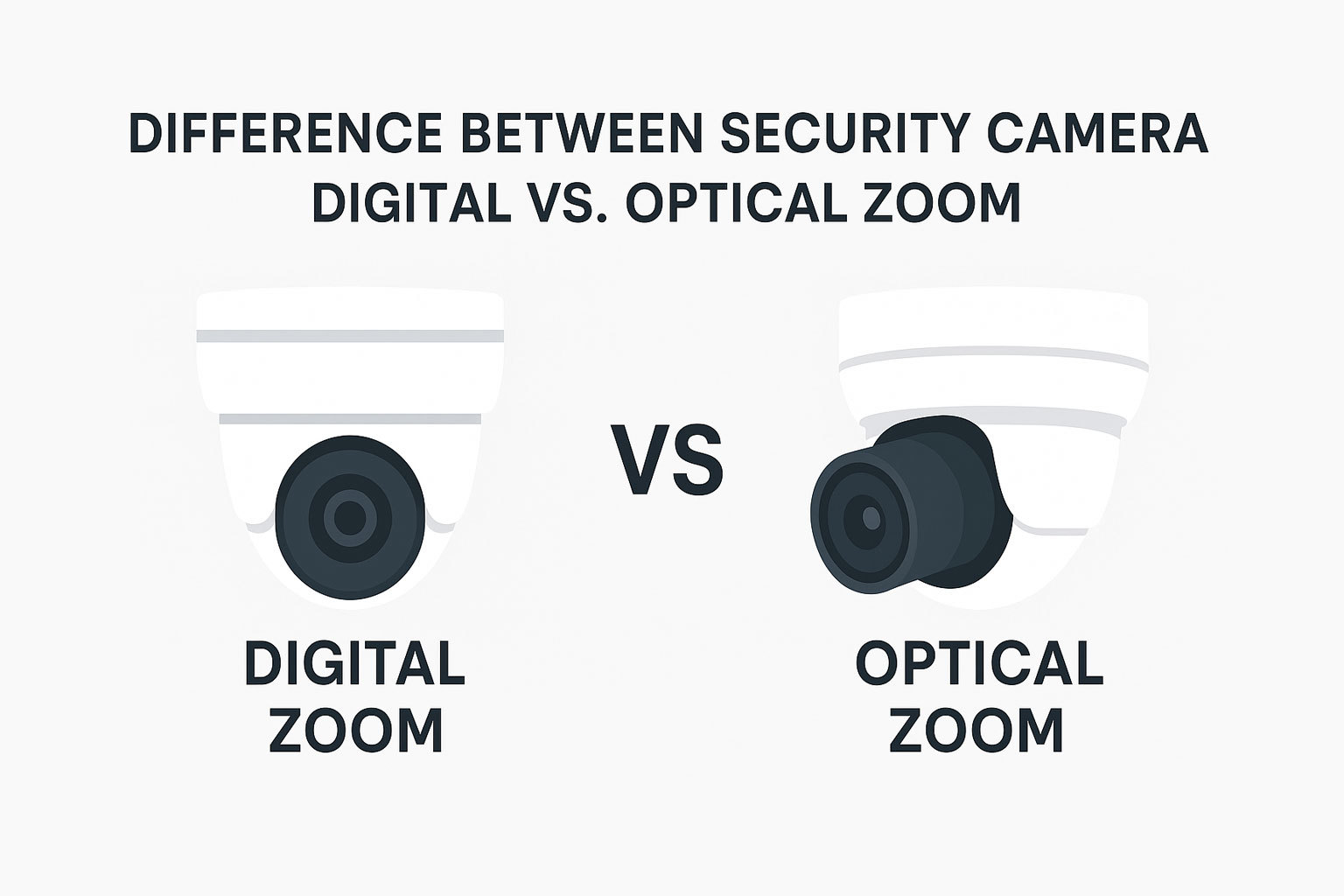
How Camera Zoom Works in Surveillance Systems
Before comparing digital and optical zoom, it helps to understand how a security camera captures images.
A typical security camera consists of three main components:
- Lens – controls how light enters the camera
- Image sensor – converts light into digital signals
- Image processor – converts signals into video footage
Zoom functions either change how the lens captures the image or how the software enlarges the captured image.
This is where the difference between optical zoom and digital zoom comes into play.
What is Digital Zoom in Security Cameras?
How Digital Zoom Works
Digital zoom is a software-based magnification process. Instead of physically adjusting the camera lens, the system simply crops a portion of the captured image and enlarges it.
Think of it like zooming in on a photo using your phone or computer. The image becomes larger, but the camera is not actually capturing more detail.
Because the system enlarges existing pixels, image quality decreases as the zoom level increases.
Advantages of Digital Zoom
Despite its limitations, digital zoom still has practical uses in many security scenarios.
Lower Cost Cameras
Cameras with digital zoom are usually more affordable because they do not require complex moving lens systems.
This makes them ideal for:
- Indoor security cameras
- Entry-level home surveillance systems
- Budget-friendly monitoring setups
Smaller Camera Size
Since digital zoom does not require mechanical lens movement, these cameras are often compact and lightweight.
This makes them suitable for:
- Mini security cameras
- Indoor smart cameras
- Doorbell cameras
Simple Installation
Digital zoom cameras generally have fewer mechanical components, which can make them easier to install and maintain.
Limitations of Digital Zoom
The biggest drawback of digital zoom is image quality loss.
Pixelation at High Zoom Levels
Because the system enlarges existing pixels, the image can become blurry or pixelated, especially when zooming in on distant objects.
For example, trying to zoom in digitally to read a license plate across a parking lot will usually result in unusable footage.
Reduced Identification Capability
If your goal is to identify faces or license plates, digital zoom may not be sufficient unless the camera is already positioned very close to the subject.
What is Optical Zoom in Security Cameras?
How Optical Zoom Works
Optical zoom uses a mechanical lens system to magnify the subject.
Instead of enlarging pixels, the camera physically adjusts the focal length of the lens, allowing it to capture more detail from a distance.
Because the image is magnified optically before it reaches the sensor, image quality remains clear and sharp.
Advantages of Optical Zoom
Optical zoom cameras are widely used in professional surveillance systems because of their superior image clarity.
Maintains Image Quality
The biggest advantage of optical zoom is that resolution remains unchanged while zooming.
This allows security personnel to clearly identify:
- Faces
- License plates
- Suspicious activities
- Small objects at long distances
Ideal for Long-Distance Monitoring
Optical zoom cameras are commonly used for:
- Parking lots
- Warehouses
- Industrial facilities
- Perimeter security
- Public spaces
In these environments, the camera may need to monitor areas 50–200 meters away, which digital zoom cannot handle effectively.
Works with PTZ Cameras
Most PTZ (Pan-Tilt-Zoom) cameras rely on optical zoom technology.
PTZ cameras allow users to:
- Rotate the camera horizontally
- Tilt vertically
- Zoom in on distant subjects
This flexibility makes them ideal for large surveillance areas.
Limitations of Optical Zoom
Although optical zoom provides excellent image quality, it also comes with a few trade-offs.
Higher Cost
Cameras with optical zoom usually cost more than digital zoom cameras because they require complex mechanical lens systems.
Larger Camera Size
The zoom lens assembly increases the physical size of the camera, which may not be suitable for compact installations.
Mechanical Components
Because optical zoom uses moving parts, it may require more maintenance over time compared to fixed-lens cameras.
Digital Zoom vs Optical Zoom: Key Differences
The following table highlights the main differences between the two technologies.
| Feature | Digital Zoom | Optical Zoom |
|---|---|---|
| Zoom Method | Software image enlargement | Physical lens magnification |
| Image Quality | Decreases when zooming | Remains clear and sharp |
| Hardware Complexity | Simple | More complex |
| Camera Cost | Lower | Higher |
| Best Use | Indoor monitoring | Long-distance surveillance |
| Common Camera Types | Indoor cameras, doorbells | PTZ cameras, outdoor security cameras |
When Should You Choose Digital Zoom?
Digital zoom can be a good option when long-distance clarity is not required.
Typical use cases include:
Indoor Security Monitoring
Inside a home or office, subjects are usually within a few meters of the camera, so digital zoom is often sufficient.
Examples include:
Living room monitoring
Office reception areas
Retail counters
Smart Home Cameras
Many smart home cameras prioritize compact design and affordability, making digital zoom a practical solution.
Doorbell Cameras
Doorbell cameras usually capture subjects within 1–3 meters, so digital zoom can work effectively.
When Should You Choose Optical Zoom?
Optical zoom becomes essential when you need clear identification at a distance.
Outdoor Security Surveillance
Large outdoor spaces require cameras that can zoom without losing detail.
Examples include:
- Parking lots
- Apartment entrances
- Driveways
- Construction sites
Business Security Systems
Businesses often require high-quality footage for incident investigation and evidence collection.
Optical zoom allows security teams to capture clear, identifiable images.
Wildlife or Remote Monitoring
Some surveillance cameras are installed in remote locations where the camera cannot be placed close to the subject.
Optical zoom helps capture clear images from far distances.
A Practical Example: Why Zoom Type Matters
Imagine installing a security camera to monitor your driveway.
Scenario 1: Digital Zoom Camera
You install a standard camera with digital zoom.
A suspicious vehicle enters your driveway at night. When reviewing the footage, you try to zoom in digitally to read the license plate.
Unfortunately, the image becomes pixelated and unclear.
Scenario 2: Optical Zoom Camera
Now imagine the same scenario with a 10× optical zoom camera.
When you zoom in, the license plate remains clear and readable, providing valuable evidence.
This example shows why choosing the right zoom technology can make a significant difference in real-world security situations.
What is a Varifocal Security Camera?
Between fixed-lens cameras and PTZ cameras, there is another option: varifocal cameras.
Varifocal cameras allow installers to manually adjust the focal length during installation, typically within a range such as:
- 2.8mm to 12mm
This allows the camera to balance:
- Viewing angle
- Zoom level
Varifocal cameras provide more flexibility than fixed-lens cameras but are usually more affordable than PTZ cameras.
How to Choose the Right Security Camera Zoom
When selecting a security camera, consider the following factors.
1. Monitoring Distance
Measure the distance between the camera and the area you want to monitor.
General guidelines:
- 0–5 meters: digital zoom is sufficient
- 5–30 meters: varifocal camera recommended
- 30+ meters: optical zoom or PTZ camera
2. Identification Requirements
Ask yourself what level of detail you need.
Security professionals often use three levels:
- Detection – noticing movement
- Recognition – identifying a person
- Identification – confirming a specific identity
If identification is required, optical zoom is usually necessary.
3. Camera Placement
Proper camera placement can significantly improve image quality.
Even the best optical zoom camera cannot compensate for poor positioning.
Key tips:
- Mount cameras at appropriate height
- Avoid strong backlighting
- Ensure the subject faces the camera
4. Budget Considerations
Security systems can range from basic home setups to professional surveillance networks.
If you are working with a limited budget, consider combining:
- Fixed cameras with digital zoom
- One PTZ camera for long-distance monitoring
This hybrid approach provides both coverage and detailed inspection capability.
The Future of Camera Zoom Technology
Modern surveillance cameras are increasingly combining optical zoom with AI-powered digital enhancement.
Some advanced systems use technologies such as:
- AI super-resolution
- Smart tracking
- Digital image stabilization
These technologies help improve digital zoom performance, but optical zoom still provides the most reliable image clarity.
Final Thoughts
Choosing between digital zoom and optical zoom security cameras depends largely on your monitoring needs.
Digital zoom cameras are affordable and suitable for short-distance indoor monitoring, while optical zoom cameras provide superior image clarity for long-distance surveillance.
For homeowners and businesses alike, understanding the difference between these two technologies can help you build a more effective and reliable security system.
When selecting a camera, always consider:
Monitoring distance
- Identification requirements
- Camera placement
- Budget
By balancing these factors, you can ensure your security camera delivers the clear, actionable footage you need when it matters most.
Related News
Target readers: security owners, system integrators, and EHS engineers for petrochemical, oil and gas, pharmaceutical, powder processing, and coal mining sites where explosive gas or combustible dust exists. Core takeaway: a normal camera is itself an ignition source in flammable environments. You must use explosion proof cameras certified to ATEX, IECEx, or China Ex, selected by hazard zone, installed with proper grounding, and documented for compliance. This guide gives a reusable selection, install, and acceptance workflow.
Nov 08,2026
4G 5G Cellular Surveillance Camera Guide: Remote Video without Broadband
Target readers: security owners and integrators for farms, orchards, fisheries, construction, oil and mining sites, vehicle fleets, and remote African villages where broadband is scarce. Core takeaway: when there is no fiber, no broadband, and frequent power loss, a SIM card cellular camera is the easiest and most scalable remote video option. This guide gives a reusable architecture covering power, data, backhaul, AI, and compliant deployment.
Nov 08,2026
Analog CCTV Upgrade Guide: Coax HD Reuse vs Full IP Rebuild, Cost and Timeline Compared
Factory, campus and retail chains running analog surveillance for five or six years face the same wall: blurry images, unretrievable footage, and no path to AI analytics on legacy hardware. This guide breaks down pre-upgrade system inventory, compares the coax-HD reuse route against a full IP rebuild, gives bandwidth and storage recalculation formulas, and lays out a zoned, non-disruptive cutover plan with a selection checklist.
Oct 31,2026
CCTV Maintenance Outsourcing: SLA Tiers, Market Rates, KPI and Contract Playbook
Conclusion first: the real cost of a surveillance system is in its operation. Three years of maintenance typically equals 30% to 50% of the build cost, yet most buyers spend the budget at install and leave operation to whoever happens to notice. Lock the maintenance boundary while signing the build contract. This guide breaks down the in-house versus outsourced decision model, a three-tier SLA (P1 / P2 / P3), per-point market rates and how to read a quote, the two KPIs that decide payment (camera online rate and footage integrity), the five clauses every contract must hold, the 90-day handover that most often loses control, plus a selection checklist and acceptance tests.
Oct 25,2026
Links:One Belt Power Technology
Add: 14th Floor, Baoshan Building, Longhua District, Shenzhen China.
Privacy Policy | SEO | CitySite | Support: 300.cn Dongguan