






Why Your “Smart” Camera Isn’t Smart Enough: The Cloud-Based Revolution in Home Surveillance
Publish:
2025-06-12 10:26
Source:
https://www.ring-see.com
The truth is harsh — most home security cameras are outdated, reactive, and largely ineffective against real threats. But the new generation of cloud-based smart surveillance cameras is rewriting the rules.
The truth is harsh — most home security cameras are outdated, reactive, and largely ineffective against real threats. But the new generation of cloud-based smart surveillance cameras is rewriting the rules. We’re entering a bold era where cameras don't just record crimes — they predict, analyze, and even respond in real time. If your security system isn't tapping into cloud intelligence, you're already behind.
Cloud Storage and Smart Playback: Local Storage Is Dead
Still storing surveillance footage on an SD card? That’s like printing emails. Cloud storage isn’t optional — it’s a necessity. Cameras now automatically upload encrypted footage to the cloud, ensuring uninterrupted loop recording and allowing users to:
Search for critical anomalies (like human intrusion or crying sounds) in seconds with AI assistance.
Skip hours of useless footage and jump straight to the moment something went wrong.
Leverage lossless compression to maximize storage — 32GB now means 15 days of high-quality, uninterrupted recording.
More importantly, cloud backups eliminate the risk of physical data theft, something no local drive can promise.
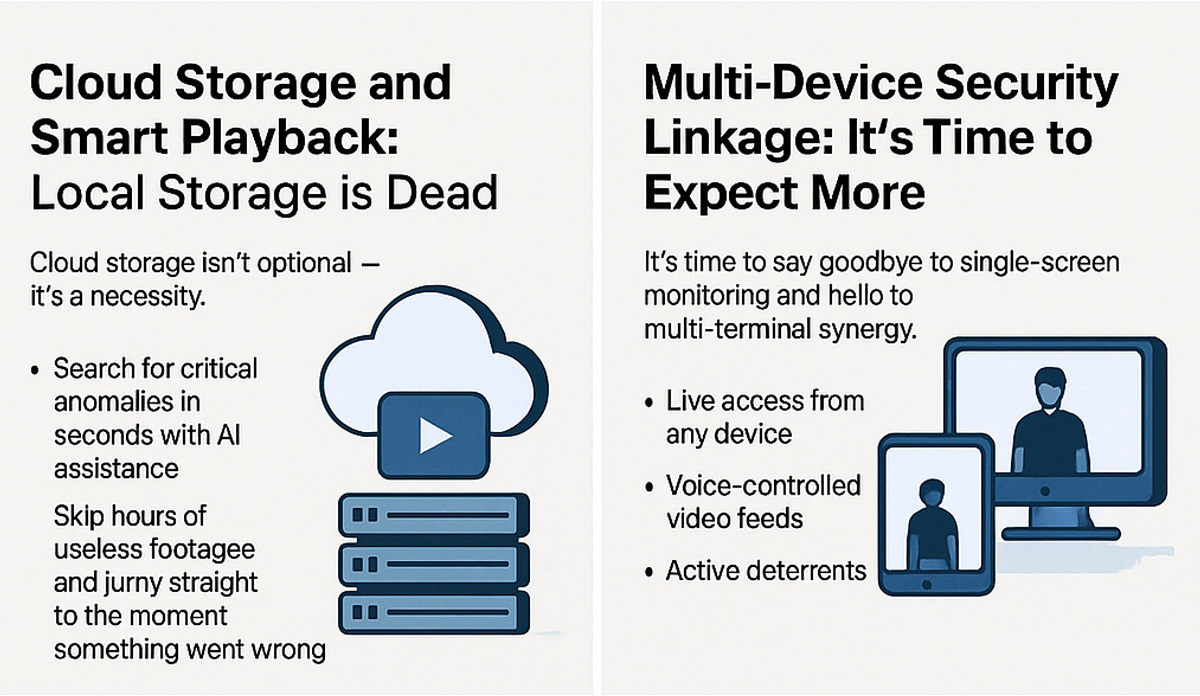
Multi-Device Security Linkage: It’s Time to Expect More
Modern home surveillance isn’t just about cameras — it’s about real-time, interconnected defense. The industry is finally saying goodbye to single-screen monitoring and hello to multi-terminal synergy:
Live access from any device — your phone, your tablet, even your car dashboard.
Voice-controlled video feeds — if your system can’t respond to commands like “show me the backyard,” it’s not smart, it’s just decorative.
Active deterrents — not just passively recording crime but actively warning intruders with flashing lights, sirens, and instant app notifications.
The bold truth? Any camera that can’t scream when there’s danger is already obsolete.
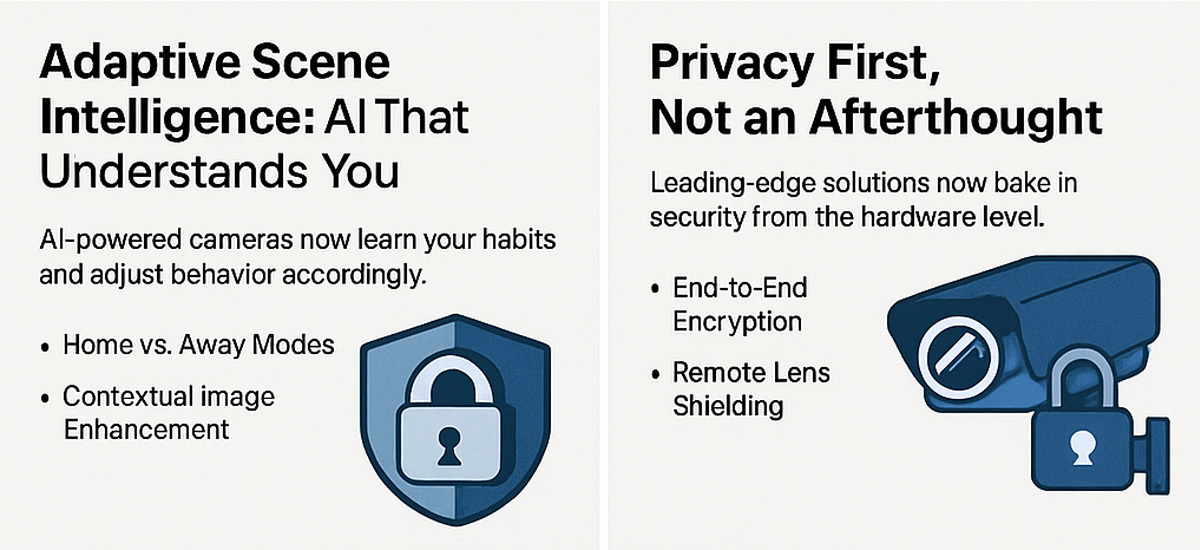
Adaptive Scene Intelligence: AI That Understands You
Why are you still getting false alarms from your pets or passing shadows? AI-powered cameras now learn your habits and adjust behavior accordingly:
Home vs. Away Modes: Sensitivity auto-adjusts depending on your presence, cutting false alarms when you're home, and ramping up when you’re not.
Contextual Image Enhancement: Using advanced cloud-side ISPs (like Haier’s hypersensitive image chips), cameras brighten low-light footage and suppress 80%+ noise, so you get sharp, meaningful visuals — not static.
Let’s be honest — if your camera can’t distinguish your dog from a burglar, it’s just an overpriced motion sensor.
Privacy First, Not an Afterthought
The surveillance industry has long been guilty of neglecting user privacy. But leading-edge solutions now bake in security from the hardware level:
End-to-End Encryption via secure chips like HiSilicon. This isn't “security theater” — this is uncrackable transmission from lens to cloud.
Remote Lens Shielding: Cameras now support physical lens cover via app — a game-changer for anyone uncomfortable with “always-on” monitoring.
And yet, many popular brands still store unencrypted footage or offer no physical privacy controls. That’s not innovation — that’s a lawsuit waiting to happen.
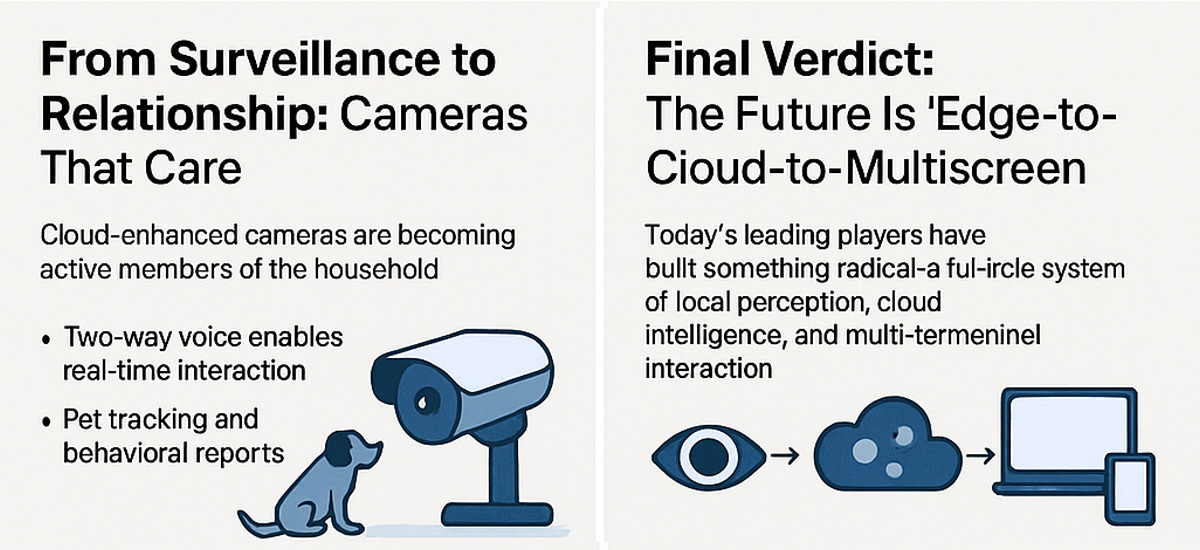
From Surveillance to Relationship: Cameras That Care
This isn’t just about security — it’s about connection and care. Cloud-enhanced cameras are becoming active members of the household:
Two-way voice enables real-time interaction. Not just checking in — responding automatically when a baby cries or when abnormal sounds occur.
Pet tracking and behavioral reports — your camera can now watch your pet's day, analyze it, and send you a summary of their wellbeing.
These aren’t gimmicks — they’re signals that the camera has evolved from a silent observer to an intelligent companion.
Comparison Chart: Legacy Cameras vs. Cloud-Powered Smart Cameras
| Feature | Legacy Cameras | Cloud-Based Smart Cameras |
|---|---|---|
| Storage | SD card / Local drive | Encrypted Cloud + Local sync |
| Playback | Manual, time-consuming | AI-powered, instant search |
| Alert System | Passive motion detection | Human-form tracking + instant push alerts |
| Device Access | Single-device (often local) | Multi-device, real-time, cross-platform |
| Security | Vulnerable to theft & leaks | Chip-level encryption + cloud backup |
| Privacy Controls | Rare or none | Remote-controlled lens blocking |
| Image Quality (Low Light) | Grainy and unclear | ISP-enhanced, noise-filteredISP |
| Voice Communication | Not supported | AI-triggered two-way voiceAI |
| Pet/Family Interaction | N/A | Smart pet tracking + activity logs |
Takeaway: If your camera is still relying on SD cards and can't tell the difference between your dog and a burglar, you're gambling with home security.
Final Verdict: The Future Is “Edge-to-Cloud-to-Multiscreen”
Today’s leading players — from Huawei’s Smart Selection (Haier) to Xiaomi’s Pan-Tilt cameras — have built something radical: a full-circle system of local perception, cloud intelligence, and multi-terminal interaction. It’s more than smart — it’s responsive, predictive, and deeply integrated.
If your current system lacks these traits, it’s not protecting you — it’s giving you the illusion of safety.
Related News
PoE was power. This is control: CCTV Network Security Hardening Guide
Short answer: video systems get breached the boring way, not through clever exploits - (1) factory default credentials never changed, (2) camera or NVR management ports forwarded to the public internet, (3) no separation between the CCTV network and the office LAN. Do three things: replace every default account and disableTelnet/FTP/UPnP/raw RTSP; put cameras in their own VLAN and only allow the NVR to initiate sessions; and reach video over VPN or a zero-trust gateway instead of a port mapping.
Oct 03,2026
PoE Power Design Guide for Security Cameras: Power Budget, Cable Voltage Drop and Distance Limits
Most "cameras keep restarting at night" incidents are not camera defects — they are power design errors. Three root causes cover the overwhelming majority of PoE failures: the power budget was sized on daytime draw instead of night peak, the cable is too thin so voltage drop exceeds the device undervoltage threshold, and the run simply exceeds the 100-metre channel limit. Memorise three numbers and you avoid most of the traps: 802.3af delivers 15.4 W, 802.3at delivers 30 W, and cable reach stops at 100 m.
Oct 03,2026
Bitrate (Mbps) is the single parameter that determines hard drive size, switch selection, and remote-viewing smoothness. Two formulas answer everything: storage per camera per day (GB) ≈ bitrate × 10.8, and total bandwidth = sum of simultaneous bitrates × 1.3 headroom. This guide covers encoding, calculation, and procurement sizing.
Sep 26,2026
CCTV Night Vision Technology Explained: Infrared vs Starlight Full-Color vs Hybrid Light
Three night vision routes and their real limits: 850nm vs 940nm infrared (red glow and range trade-offs), the lux threshold of true starlight cameras (0.001-0.005 lux), light-pollution risks of warm-light supplement, and AI-triggered hybrid switching — plus a six-point datasheet verification method and a 20-minute night PoC test.
Sep 26,2026
CCTV Lens Selection Technical Guide: Focal Length, Pixel Density & the DORI Standard in Practice
Why can't a 4K camera read faces? Because identification depends on pixel density, not total pixels. Using the EN 62676-4 DORI standard, this guide gives the full focal-length / distance / field-of-view formulas, a lens selection lookup table, and the real impact of sensor size and aperture on night vision.
Sep 19,2026
Links:One Belt Power Technology
Add: 14th Floor, Baoshan Building, Longhua District, Shenzhen China.
Privacy Policy | SEO | CitySite | Support: 300.cn Dongguan