





Night Vision & Low-Light Camera Selection Guide: IR, Full-Color, Starlight, Blacklight
Publish:
2026-08-08 15:07
Source:
https://www.ring-see.com
Night vision is the part of surveillance camera procurement where "the specs look prettiest but the field result fails hardest." A camera rated "50 m night vision" often turns into a blurry blob beyond 20 m once installed; a model advertised as "0-lux full color" still relies on its补光灯 (fill light) when it gets pitch dark. The problem is rarely buyer incompetence — it is that "night vision" hides four completely different technical routes: infrared, full-color fill light, starlight, and blacklight (AI-ISP). Their use cases, power draw, and cost differ enormously.
This article uses a practical selection framework to unpack parameters like "illuminance lux," "ICR filter," "sensor size," "aperture F-number," and "IR wavelength 850/940 nm," giving an empirical formula for illumination distance, the knock-on effect of low light on bitrate / traffic / storage, plus a 5-step decision tree and a procurement verification checklist. After reading you should be able to answer one core question: given a scenario and budget, which night-vision route to choose, and how to see through spec overstatement.
1. Why Night Vision Is Where Procurement Fails Most
Conclusion first: 90% of night-vision failures are wrong route chosen + wrong metric read, not a broken device.
Typical failure samples:
- Distance overstatement: A model rated "50 m night vision" can only show a moving bright blob beyond 20 m, unable to identify a face. Reason: vendors rate distance by "can detect the target's outline," while buyers understand it as "can clearly recognize a face."
- Red glow complaints: An 850 nm IR camera in an apartment corridor shows a ring of dim red dots at night; residents think they are being secretly filmed and complain to property management.
- Full-color light too intrusive: Full-color night vision in a farm / warehouse flashes bright white when someone passes, spooking livestock, attracting insects, and drawing extra power (directly conflicting with the power budget in the off-grid article).
- ICR flicker: At dusk临界 illuminance, the filter fl/ickers between color and mono, the picture flashes on and off.
- Fake night vision: Cheap models just brighten the daytime image in software and call it "night vision"; turn off the lights and the screen goes black.
These four traps share one root cause: they come from treating "night vision" as a switch, not as a set of technical parameters that must match the scenario. The next two sections clarify the measurement units.
2. Understanding "Illuminance lux": the Difference Between 0.001 and 0
All night-vision discussion starts with illuminance (lux) — the luminous flux received per unit area. Memorize the illuminance of a few typical environments as ranges (industry-common reference values, not absolute standards):
Environment | Illuminance range (typical) |
Clear sunny outdoor | 10,000–100,000 lux |
Cloudy outdoor | 1,000–10,000 lux |
Indoor office | 300–500 lux |
Dusk / dawn | 1–10 lux |
Moonlit night (unobstructed) | 0.1–0.3 lux |
Starlight night (moonless) | 0.001–0.01 lux |
Overcast sealed dark night | below 0.0001 lux |
Fully dark (no ambient light) | 0 lux |
Key distinctions:
- 0.001 lux is not 0 lux. 0.001 lux still has faint starlight / sky glow; starlight sensors use it to produce color. 0 lux is truly lightless; any visible-light camera can only image via active fill light (IR or white light).
- When a vendor claims "minimum illuminance 0.001 lux," ask under what gain / exposure conditions it was measured. The same sensor, with exposure stretched to seconds and gain maxed out, can produce an image at 0.001 lux — but a moving target smears into a ghost.
One sentence: lux figures must be read together with test conditions; an isolated "0.001 lux" is meaningless.
A frequently overlooked real-world trap: a camera rated "minimum illuminance 0.001 lux" is often measured at the extreme of maxed gain + long single-frame exposure, by which point the image is already a "watercolor noise painting" — it only proves "a signal exists," not "it is usable." What you should really ask is: at an acceptable noise level (e.g. SNR ≥ 50 dB), what is the minimum usable illuminance? For the same sensor, the usable illuminance may be an order of magnitude higher than the rated value. If a vendor gives only the extreme value and not the "usable value," you can basically conclude they are playing word games.
3. Comparison of Four Night-Vision Routes
Route | Imaging principle | Needs fill light? | 0-lux full color | Typical range / recognition | Power profile | Use case |
IR (850 nm) | IR fill + mono imaging | Yes (IR) | No (mono) | 10–80 m (rated) | Medium | Parks, warehouses, roads |
IR (940 nm) | Same, invisible wavelength | Yes (IR, no red glow) | No (mono) | ~30%–50% shorter than 850 nm | Medium | Residential, covert |
Full-color (white light) | Warm/white fill + color imaging | Yes (visible) | Yes (via light) | 10–30 m (limited by lamp power) | High (lamp draws power) | Entrances, color evidence |
Starlight | Large sensor + large aperture + low-noise ISP, uses faint ambient light | No (no fill) | Yes (needs ≥0.001 lux faint light) | Depends on ambient light; black with no light | Low | Faint-light sites, cities |
Blacklight / AI-ISP | Dual-sensor fusion or AI brightening & denoise | Mostly "optional fill" | Claimed yes (some need faint light / fill) | Depends on solution | Medium–High | High-end perimeters, lightless sites |
Beware the "blacklight" marketing: many models labeled "blacklight full color 0 lux" still rely on fill light or heavy frame accumulation in reality — not true lightless full color. When procuring, insist on real shots in a lightless, fill-light-off environment, not the spec sheet.
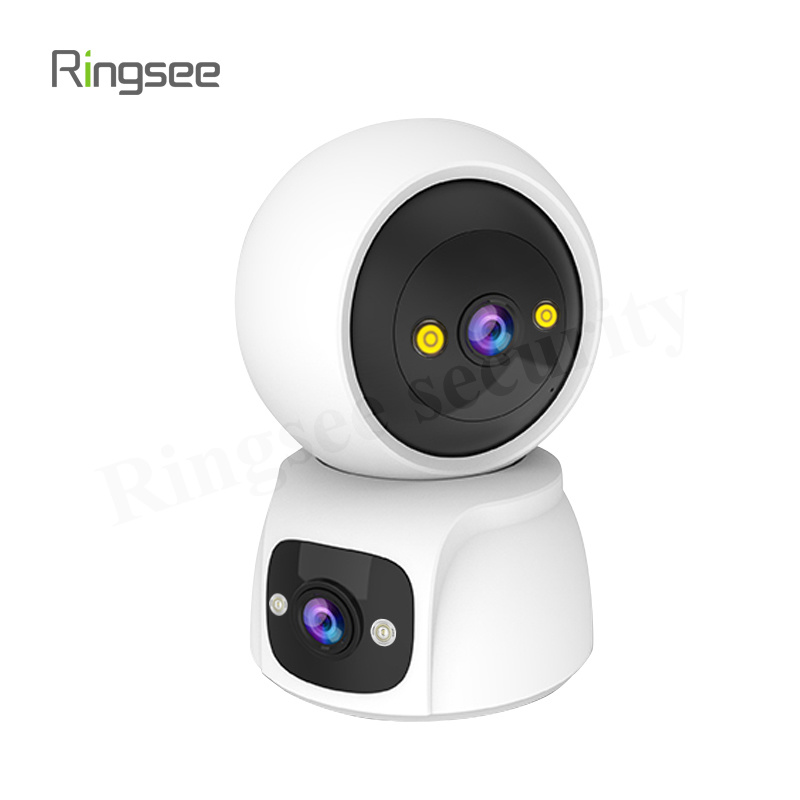
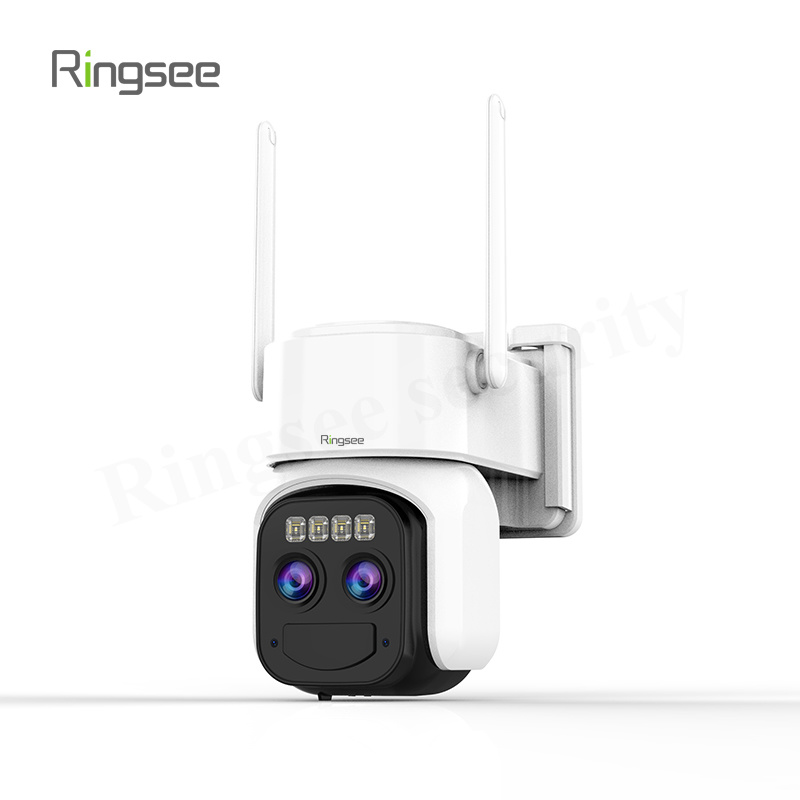
Trade-offs of dual / triple-light fusion models: Common "IR + white light" dual-fill or "IR + white + warm" triple-fill models essentially use different light sources to cover different needs — IR for distance, white for color, warm to attract fewer insects. The cost is hardware cost and power draw rising together, and if the multi-source switching logic is poorly tuned, it flickers more easily than a single source. Decide by "do you truly need color evidence," and don't pay for light sources you won't use.
4. Four Hardware Parameters That Decide Low-Light Performance
Night-vision capability is not a single number but a combination of four hardware parameters:
1. Sensor size
The larger the sensor, the more light per pixel, the cleaner the low light. Common industry tiers (typical):
- 1/2.8″: Entry-level, ordinary low light, night vision mostly relies on IR.
- 1/1.8″: Mid-to-high-end mainstream, common for starlight.
- 1/1.2″: High-end, light intake several times that of 1/2.8″, clear low-light advantage.
Rule of thumb: with the same aperture and ISP, each step up in sensor size lowers the usable low-light illuminance by about one step.
2. Aperture F-number
The aperture controls light intake; smaller F-number means more light:
Light intake ∝ (1 / F-number)² × exposure time T
Example: F1.0 light intake = (2.0/1.0)² = 4× that of F2.0
So an F1.0 lens gathers 4× more light than F2.0 in low light — a world of difference in starlight performance. The cost is shallower depth of field and higher price.
3. ICR infrared cut filter
Daytime uses IRCUT to block IR for true color; nighttime it is removed to let IR through and boost sensitivity. The switching pitfalls are covered in section 5.
4. Noise reduction and frame accumulation (3D DNR / Slow Shutter)
- 3D DNR: Multi-frame noise reduction, suppresses noise in low light, almost mandatory.
- Frame accumulation / slow shutter: Extends exposure to brighten low light, but moving targets smear. Typically for static scene monitoring, not for traffic or fast-moving people.
The noise floor (SNR) is the invisible ceiling of low light: at extremely weak light the signal is comparable to the circuit's inherent noise, and stronger gain only amplifies the noise together. The industry uses signal-to-noise ratio SNR (dB); a starlight sensor at 0.01 lux commonly rates SNR in the typical 50–65 dB range; below that the picture "snows out." So low light is not "infinite gain" but gathering light as much as possible within the usable SNR threshold — which also explains why large sensor + large aperture beats simply piling on gain.
Iron rule: low light = large sensor × large aperture × strong denoise × reasonable exposure; piling on just one yields diminishing returns.
From a cost gradient, the four routes are roughly: IR mono (most mature and cheap) < 940 nm IR (slightly dearer) < starlight (sensor & ISP premium) < blacklight / dual-light fusion (highest). Procure by working the budget backward from "does the scenario truly need high-end capability," avoiding paying for low-light performance you won't use — exactly the same "match to need" thinking as the power and connectivity articles.
5. IR Fill Light: 850 nm vs 940 nm, Range, and Power
IR is currently the most mainstream night-vision fill method; the core is wavelength choice:
Parameter | 850 nm | 940 nm |
Human visibility | Visible dim red dot (red glow) | Essentially invisible (no red glow) |
Sensor response efficiency | High | Low (~30%–50% attenuation) |
Same-power range | Far | Short (about 60%–70% at same power) |
Typical use | Parks/warehouses (don't care about red dots) | Residential / covert surveillance |
Empirical formula for illumination distance (not exact, for initial screening):
Effective recognition distance ≈ IR power factor × lens aperture factor × sensor sensitivity factor
"Recognition" per Johnson's criteria:
- Detection (discover): target occupies ≥ 2 pixels
- Recognition (person/vehicle): target occupies ≥ 4 pixels
- Identification (face/plate): target occupies ≥ 8–12 pixels
Vendor-rated distance mostly corresponds to the "detection" tier, not "identification" — that is the root cause of "50 m rated, blurry at 20 m."
IR LED lifespan and thermal trap: IR LEDs are often rated 10,000–30,000 hours (typical), but that is the lab value "until light decays to 70%," heavily affected by thermal design — an LED running hot long-term inside a sealed housing accelerates light decay, and night-vision range silently shrinks after two or three years. Don't just look at rated power; ask about the housing's heat-dissipation structure (metal substrate / thermal path) and high-temperature power-derating strategy. Also, IR LEDs have uneven illumination ("bright center, dark edges"); cheap models often skip diffuser treatment, leaving dark corners — field testing must capture corner detail in a fully dark environment, not just the center.
Power note: IR lamp power is typically in the 1–5 W range; continuous operation is a real burden on off-grid solar systems (see the power budget and battery selection in *"4G + Solar Off-Grid Monitoring Selection Guide"*).
6. ICR Filter Switching: False Color, Tint, Flicker
ICR (Infrared Cut filter Removal) is the key component for daytime fidelity and nighttime sensitivity, but has three common faults:
- False color / tint: ICR not fully closed, daytime picture purples / reds. Usually mechanical failure or driver delay.
- Critical flicker: Dusk illuminance fluctuates around the switching threshold, the filter flips back and forth, the picture flashes color then black. Solved by hysteresis threshold (gap between enter and exit thresholds) and a light sensor.
- Switching delay: Several seconds of blind spot from light to dark, missing key events. High-end models use software-assisted transitions.
Procurement check: require the vendor to state the switching illuminance threshold and hysteresis range, and do a rapid "light ↔ dark" switch test on site to see if there is flicker or delay.
A note on mechanical life: ICR is driven by a micro-motor physically moving the filter, switching once each sunrise and sunset — about 700 actions per year; cheap motors after a year or two can "stick midway," causing daytime tint or nighttime insensitivity. For high-reliability scenarios (e.g. 7×24 perimeter), choose a dual-filter + industrial-grade motor solution, and write "switch-cycle life" into the procurement spec, not just the switching function itself.
7. Night Vision's Knock-On Effect on Bitrate / Storage / Traffic / Bandwidth
Night vision is not an isolated parameter; it amplifies cost along the chain "imaging → encoding → transmission → storage." This directly ties to the traffic formula in *"4G + Solar Off-Grid Monitoring Selection Guide"*:
Monthly traffic (GB) ≈ avg bitrate (Mbps) × daily upload hours (h) × 30 ÷ 8
Night-vision mode's effect on bitrate (typical):
- IR mono: fewer details, relatively low bitrate
- Full-color fill: rich detail + lamp highlights, bitrate may be 20%–50% higher
- Starlight / blacklight full color: more color detail, bitrate on the higher side
Chain conclusions:
- Off-grid 4G scenario: Continuous full-color bitrate quickly eats IoT SIM traffic; recommend nighttime event-triggered upload rather than 24h main stream.
- Storage scenario: At the same resolution, full-color night vision uses more storage than IR mono; size the NVR disk enlarged by "night-vision share."
- Bandwidth scenario: Multiple concurrent full-color streams saturate upstream bandwidth; plan bitrate caps and sub-streams.
One sentence: the "clearer" the night vision, the "pricier" the downstream transmission and storage. Account for the full chain, not just front-end specs.
Quantified example: An off-grid 4G site, daytime main stream 2 Mbps, at night if switched to full color ~3 Mbps. By the traffic formula in *"4G + Solar Off-Grid Monitoring Selection Guide,"* 24h full-color upload → monthly traffic ≈ 3 × 24 × 30 ÷ 8 ≈ 270 GB, far exceeding the typical IoT SIM 1–10 GB/month tier — cost explodes. Switch to "event-trigger + sub-stream (0.5 Mbps) backhaul" and monthly traffic drops to under 10 GB. Same hardware, wrong bitrate strategy, cost differs by an order of magnitude — that is the real value of reading the night-vision, power, and connectivity articles together.
8. Typical Scenario Selection Table
Scenario | Ambient light feature | Recommended route | Reason |
Apartment corridor / elevator lobby | Faint always-on light | Starlight or 940 nm IR | Faint light suffices, 940 nm no red glow, no nuisance |
Park perimeter / warehouse | Fully dark, long range | 850 nm IR (mid-long range) | Range priority, don't care about red dots |
Shop entrance / checkout | Need color evidence | Full-color (white light) | Color helps identify people/objects |
Road / checkpoint | Headlight backlight, needs WDR | Starlight + true WDR (≥120 dB) | Low light + backlight both covered |
Farm / pasture (off-grid) | Fully dark, tight power | 850 nm IR + event trigger | Saves power, long range, no insects |
Border / high-end perimeter (lightless) | Truly 0 lux | Blacklight / dual-light fusion + optional fill | Lightless full-color need |
9. 5-Step Decision Tree
- Is there light on site?
- Faint light (≥0.001 lux) → prefer starlight, no fill light, most power-saving.
- Fully dark (0 lux) → must use fill light, go to step 2.
- Need color or is mono enough?
- Only need motion / outline → IR mono (most economical).
- Need face/plate color → full-color fill or blacklight.
- Care about red dots / disturbance?
- Residential / covert → 940 nm or full color (no red glow).
- Park / warehouse → 850 nm (longer range).
- Is power / traffic tight?
- Off-grid / expensive traffic → IR + event trigger, forbid 24h full-color main stream.
- Wired / ample bandwidth → can go full color or blacklight.
- Budget and lifespan?
- Low budget → IR model (mature, cheap).
- High requirement → starlight / blacklight (higher hardware cost, but saves fill-light O&M).
Decision core: first use "is there light" to cut half the routes, then use "need color + is power tight" to settle the final plan.
Walkthrough: An off-grid farm needs to see the magnitude of sheep-pen movement at night (no face ID needed).
- Step 1: Sheep pen fully dark (0 lux) → must use fill light;
- Step 2: Only need motion outline, mono suffices → exclude full color / blacklight;
- Step 3: Open area, afraid of attracting insects, no red-dot concern → 850 nm IR (long range);
- Step 4: Solar-powered, 4G traffic expensive → IR + event trigger, forbid 24h full color;
- Step 5: Limited budget → IR model most cost-effective.
Conclusion: 850 nm IR + event-triggered upload, perfectly matching the power / traffic budget in *"4G + Solar Off-Grid Monitoring Selection Guide."* If it were a "shop entrance needing face ID," step 2 would turn to full-color fill — same decision tree, different inputs, different outputs.
10. The Ceiling of Visible-Light Night Vision: When to Turn to Thermal
All routes above assume "there is visible light (including IR) to reflect." But there is a class of scenarios where visible-light night vision systematically fails:
- Fully dark + fully obstructed: tunnels, sealed warehouses, smoke-filled environments where IR is also absorbed;
- Camouflage / vegetation cover: a person hidden behind bushes, visible light only captures leaves;
- Only care about "is there a heat source": perimeter defense only wants to catch intruders, not their looks.
This is when to consider thermal imaging: images by temperature difference between object and background, independent of ambient light, unaffected by smoke, bushes, or full darkness, and inherently covert (emits no light). The cost is low resolution, no color, high unit price (typically several times that of a comparable visible-light camera), and export / use compliance restrictions in most regions.
Practical conclusion: visible-light night vision is for "seeing clearly," thermal is for "detecting." High-security perimeters often combine both into a dual-spectrum dome — thermal alarms first, visible light zooms in to identify. Don't jump to thermal upfront (expensive and overkill); exhaust the visible-light routes in the first nine sections first; only when "fully dark / obstructed / detection-only" holds should thermal be a supplement, not a replacement.
11. Procurement Verification Checklist + FAQ
6 must-test on arrival:
- Shoot in a fully dark environment (lights and windows off) to confirm it "truly images" vs "black screen";
- For IR models, test 850/940 nm distinction, check for red glow;
- Use a lux meter to measure the site's minimum lux, compare with the vendor's "minimum illuminance" test conditions;
- Rapid light ↔ dark switch, check if ICR flickers / delays;
- For full-color models, measure fill-light power (count into daily consumption when on off-grid systems);
- Pull back to 40% of the rated distance and see if you can identify a face / plate (verify the "identification tier," not "detection tier").
FAQ
Q: Why is "50 m night vision" blurry at 20 m?
A: Rated distance mostly corresponds to Johnson's "detection tier" (target ≥2 pixels), not "identification tier" (≥8–12 pixels). For recognizable faces, the usable distance is often only 30%–50% of the rated value. Ask which tier is rated.
Q: Is blacklight really 0-lux full color?
A: Partly marketing. True lightless full color needs dual-sensor fusion or strong AI-ISP, and most still keep a fill-light option. Insist on lightless, fill-light-off real shots, not the spec sheet.
Q: How to choose 940 nm vs 850 nm?
A: Residential / covert → 940 nm (no red glow); park / warehouse needing range → 850 nm (higher efficiency, longer range). At same power, 940 nm range is about 60%–70% of 850 nm.
Q: Can starlight work with no light at all at night?
A: No. Starlight relies on ≥0.001 lux faint light (star glow / distant lights) for color; true 0-lux darkness still needs fill light or IR switch.
Q: Does full-color night vision draw a lot of power?
A: Yes. White fill-light power is typically higher than IR, a clear burden on off-grid systems; recommend event-triggered lighting, not always-on.
Q: How to tell starlight from blacklight by eye?
A: Look at the "lightless, fill-light-off test": starlight in full darkness (0 lux) must rely on IR or switch to mono — still微-light dependent; blacklight (dual sensor / AI-ISP) claims color closer to 0 lux. If a vendor refuses to provide lightless full-dark samples, it is most likely a starlight relabeled as blacklight.
Closing
The essence of night-vision selection is matching "how much you see" against "how much power / bandwidth / money you spend": with faint light, go starlight to save fill light; in full darkness, honestly use fill light; for color evidence, accept the fill light's power draw and disturbance; for off-grid, prefer IR + event trigger. Use the lux ranges, Johnson's tiers, the bitrate chain math, and the 5-step decision tree in this article and you'll avoid most "pretty specs, failed field" traps.
An emphasis on selection order: set the night-vision route first, then talk about housing protection. Even the strongest night vision is useless if the housing floods, is destroyed by lightning, or corrodes from salt spray — night vision solves "how clearly you see in the dark," while IP protection and lightning protection solve "whether it survives the next rainy season." These are the two indispensable defenses of an outdoor camera; pair this article with the upcoming *"IP66/IP67 Protection & Lightning Protection Selection Guide"* to cover the full lifecycle from "how to keep running" to "how clearly you see" to "how long it lasts."
If your project also involves power and connectivity (wired PoE, Wi-Fi, or 4G + solar off-grid), we recommend reading *"Power × Connectivity: 12-Combination Decision Tree"* and *"4G + Solar Off-Grid Monitoring Selection Guide"* together — the three articles cover the complete decision chain of an outdoor camera from "how to keep running" to "how clearly you see in the dark."
*(Ringsee / Shenzhen Ringsee Security Technology has focused on outdoor security surveillance since 2002; its starlight and blacklight models have many deployed cases in low-light scenarios such as park perimeters, off-grid farms, and borders, and can provide corresponding hardware combinations per the framework above.)*
Related News
Analog CCTV Upgrade Guide: Coax HD Reuse vs Full IP Rebuild, Cost and Timeline Compared
Factory, campus and retail chains running analog surveillance for five or six years face the same wall: blurry images, unretrievable footage, and no path to AI analytics on legacy hardware. This guide breaks down pre-upgrade system inventory, compares the coax-HD reuse route against a full IP rebuild, gives bandwidth and storage recalculation formulas, and lays out a zoned, non-disruptive cutover plan with a selection checklist.
Oct 31,2026
CCTV Maintenance Outsourcing: SLA Tiers, Market Rates, KPI and Contract Playbook
Conclusion first: the real cost of a surveillance system is in its operation. Three years of maintenance typically equals 30% to 50% of the build cost, yet most buyers spend the budget at install and leave operation to whoever happens to notice. Lock the maintenance boundary while signing the build contract. This guide breaks down the in-house versus outsourced decision model, a three-tier SLA (P1 / P2 / P3), per-point market rates and how to read a quote, the two KPIs that decide payment (camera online rate and footage integrity), the five clauses every contract must hold, the 90-day handover that most often loses control, plus a selection checklist and acceptance tests.
Oct 25,2026
CCTV NVR Selection & Recording Management: Channels, Decoding, ONVIF, Retention & Storage
Conclusion first: an NVR channel count is a license count, not a physical port count. Spec the machine by two hard numbers — intake bandwidth and decoding capacity — then by ONVIF compatibility and storage strategy. The three most common failures are: it records but the local preview stutters, mixed brands drop smart events, and desktop drives fail within a year. This guide covers architecture choice (embedded NVR / hybrid / VMS / edge), the three hard metrics (channels, intake bandwidth, decoding), ONVIF Profile compatibility and acceptance, recording plans and the retention-capacity formula, RAID and surveillance-drive selection, playback and forensic search, and the contract fields plus acceptance tests that stop disputes.
Oct 25,2026
Bottom line: AI surveillance is not turn it on and it works. In engineering you must first decide where compute runs - in the camera (edge), in the recorder or server (center), or both - choose the right algorithm and know its accuracy preconditions, then use three moves: rule tightening, environment adaptation, and multi-stage verification, to push false alarms from dozens per day to usable. A camera that alarms all day is as good as no camera. This guide upgrades the earlier consumer view of how to choose an AI camera into a B2B engineering deployment view: how to choose the compute architecture, how to control false alarms, and how AI connects to image quality, bandwidth, and security covered in earlier articles.
Oct 17,2026
Links:One Belt Power Technology
Add: 14th Floor, Baoshan Building, Longhua District, Shenzhen China.
Privacy Policy | SEO | CitySite | Support: 300.cn Dongguan