














































































7 Must-Have Features of a 4G Solar Security Camera in 2025 | Ringsee China Manufacturer
Publish:
2025-09-16 11:45
Source:
https://www.ring-see.com
Discover the top 7 features every 4G solar security camera must have in 2025. Learn about AI detection, 2K/4K video, long-lasting solar power, and weatherproof design. Ringsee – leading OEM/ODM manufacturer and supplier of solar 4G cameras in China.
In 2025, the demand for 4G solar security cameras continues to rise as homeowners, businesses, and outdoor property managers look for reliable, wire-free surveillance solutions. Unlike traditional WiFi cameras, a 4G solar-powered security camera combines energy independence with flexible connectivity, making it ideal for remote areas without electricity or internet access.
If you are considering investing in a solar 4G surveillance system, here are the 7 must-have features to look for this year.
Reliable 4G LTE Connectivity
A key advantage of a 4G security camera is its ability to work where WiFi doesn’t reach. Ensure the device supports global 4G LTE bands and is compatible with major carriers in your region. This guarantees stable video streaming, real-time alerts, and remote monitoring through mobile apps.
High-Resolution Video (2K or 4K)
Clear footage is critical for effective security. In 2025, most leading solar-powered CCTV cameras now offer 2K or even 4K ultra-HD resolution, enabling users to zoom in on details like license plates or faces without losing clarity. Advanced image processing and enhanced night vision security camera features further improve performance.
Intelligent AI Detection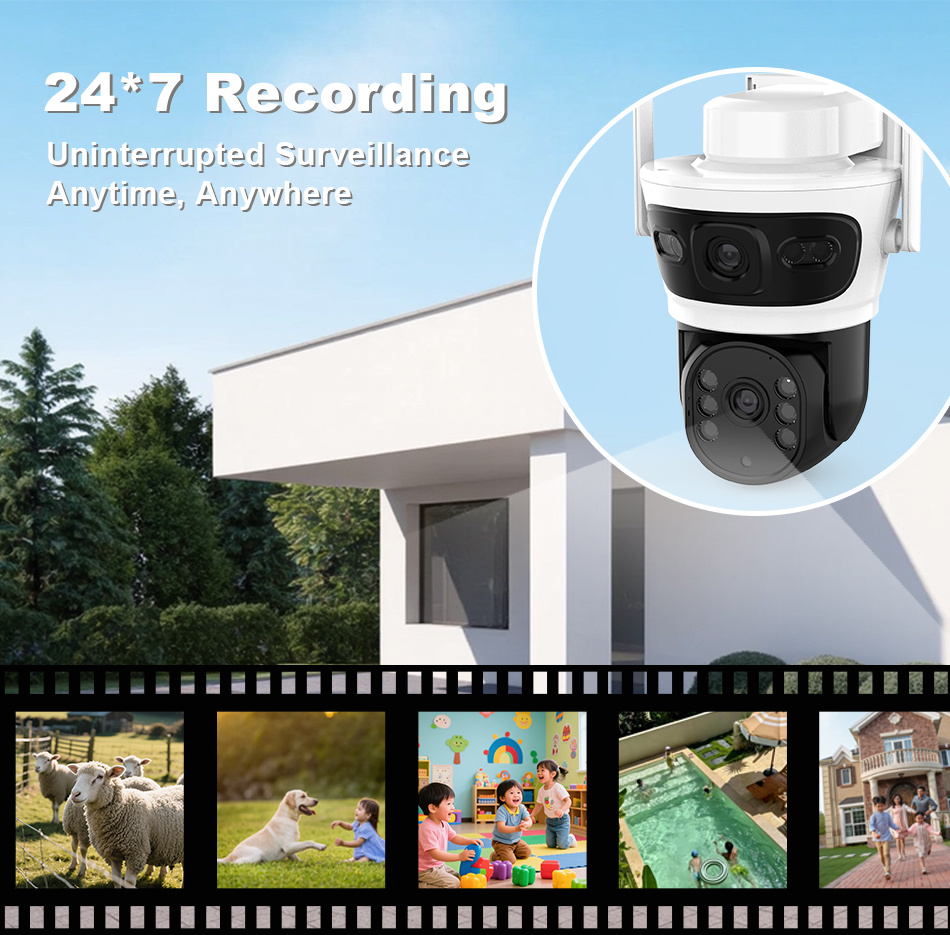
Modern surveillance goes beyond simple motion detection. The best solar 4G cameras feature AI-powered smart detection that can differentiate between humans, vehicles, animals, and irrelevant movements like tree branches swaying. This reduces false alarms and ensures accurate security alerts.
Long-Lasting Solar & Battery Performance
A solar security system is only as good as its power setup. Look for models equipped with:
High-efficiency solar panels for faster charging.
Large-capacity lithium batteries that last through cloudy days or low-light seasons.
Smart power-saving modes to extend operation during heavy usage.
Wide-Angle Dual-Lens or PTZ Function
Coverage matters. In 2025, many outdoor solar security cameras include dual-lens technology or PTZ (Pan-Tilt-Zoom) features, giving you broader viewing angles and the ability to track suspicious activity across a wider area. This reduces blind spots and enhances property protection.
Encrypted Cloud & Local Storage
Security isn’t only about video capture—it’s also about data protection. The latest 4G solar surveillance cameras support encrypted cloud storage as well as local SD card backup, ensuring your recordings remain safe even if the device is stolen or damaged.
Weatherproof and Rugged Design
Outdoor security demands durability. The must-have cameras in 2025 are built with IP66/IP67 waterproofing, anti-rust housing, and temperature-resistant components. These features allow outdoor solar-powered cameras to withstand rain, snow, dust, and extreme heat while continuing to operate smoothly.
The best 4G solar security cameras in 2025 combine power independence, reliable connectivity, and intelligent features to provide all-around protection in any environment. Whether you’re safeguarding a remote farm, monitoring construction sites, or simply enhancing home security, choosing a model with these seven must-have features will ensure long-lasting performance and peace of mind.
Related News
Target readers: security owners, system integrators, and EHS engineers for petrochemical, oil and gas, pharmaceutical, powder processing, and coal mining sites where explosive gas or combustible dust exists. Core takeaway: a normal camera is itself an ignition source in flammable environments. You must use explosion proof cameras certified to ATEX, IECEx, or China Ex, selected by hazard zone, installed with proper grounding, and documented for compliance. This guide gives a reusable selection, install, and acceptance workflow.
Nov 08,2026
4G 5G Cellular Surveillance Camera Guide: Remote Video without Broadband
Target readers: security owners and integrators for farms, orchards, fisheries, construction, oil and mining sites, vehicle fleets, and remote African villages where broadband is scarce. Core takeaway: when there is no fiber, no broadband, and frequent power loss, a SIM card cellular camera is the easiest and most scalable remote video option. This guide gives a reusable architecture covering power, data, backhaul, AI, and compliant deployment.
Nov 08,2026
Analog CCTV Upgrade Guide: Coax HD Reuse vs Full IP Rebuild, Cost and Timeline Compared
Factory, campus and retail chains running analog surveillance for five or six years face the same wall: blurry images, unretrievable footage, and no path to AI analytics on legacy hardware. This guide breaks down pre-upgrade system inventory, compares the coax-HD reuse route against a full IP rebuild, gives bandwidth and storage recalculation formulas, and lays out a zoned, non-disruptive cutover plan with a selection checklist.
Oct 31,2026
CCTV Maintenance Outsourcing: SLA Tiers, Market Rates, KPI and Contract Playbook
Conclusion first: the real cost of a surveillance system is in its operation. Three years of maintenance typically equals 30% to 50% of the build cost, yet most buyers spend the budget at install and leave operation to whoever happens to notice. Lock the maintenance boundary while signing the build contract. This guide breaks down the in-house versus outsourced decision model, a three-tier SLA (P1 / P2 / P3), per-point market rates and how to read a quote, the two KPIs that decide payment (camera online rate and footage integrity), the five clauses every contract must hold, the 90-day handover that most often loses control, plus a selection checklist and acceptance tests.
Oct 25,2026
Links:One Belt Power Technology
Add: 14th Floor, Baoshan Building, Longhua District, Shenzhen China.
Privacy Policy | SEO | CitySite | Support: 300.cn Dongguan