














































































The Role of AI-ISP Technology in Modern Security Camera
Publish:
2025-06-30 10:04
Source:
https://www.ring-see.com
AI-ISP technology (Artificial Intelligence – Image Signal Processing) is reshaping the future of smart security camera by deeply integrating AI algorithms into traditional image processing pipelines.
AI-ISP technology (Artificial Intelligence – Image Signal Processing) is reshaping the future of smart security camera by deeply integrating AI algorithms into traditional image processing pipelines. As security challenges grow more complex, especially in low-light and dynamic environments, AI-ISP enables cameras to make intelligent decisions in real-time.
According to a report by MarketsandMarkets, the global AI in the video surveillance market is expected to grow from USD 4.9 billion in 2023 to USD 14.1 billion by 2028, reflecting the rapid adoption of intelligent monitoring systems powered by technologies like AI-ISP.
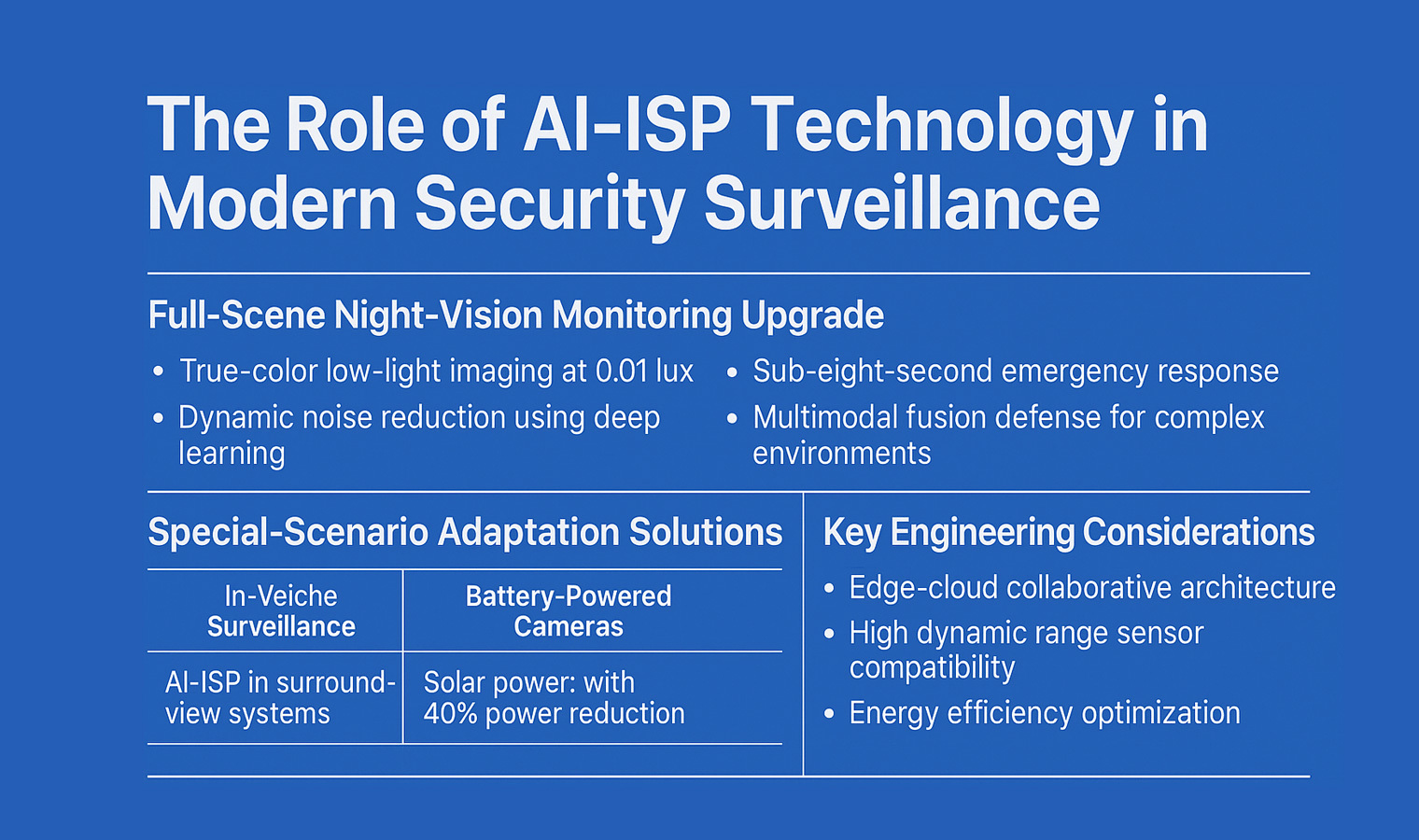
Full-Scene Night-Vision Monitoring Upgrade
True-Color Low-Light Imaging
Conventional low-light security cameras rely heavily on infrared fill lights, which cause color distortion and light pollution. In contrast, AI-ISP cameras are capable of producing full-color images in near-total darkness (as low as 0.01 lux), eliminating the need for external illumination.
This black-light full-color imaging is particularly valuable in areas such as prison perimeters, military outposts, and border surveillance, where uninterrupted visibility is critical. Field tests have shown that AI-ISP technology can increase night-time crime identification rates by up to 40%, making it a game-changer in nocturnal monitoring.
Dynamic Noise Reduction Optimization
AI-ISP technology utilizes deep learning noise reduction models to suppress grain and enhance clarity in night-time video. Signal-to-noise ratios improve by 6–12 dB, effectively solving issues like license plate blur and facial distortion. This results in more accurate detection and recognition during critical night surveillance operations.
Intelligent Security System Integration
Sub-Eight-Second Emergency Response
Smart surveillance systems powered by AI-ISP can automatically detect and respond to anomalies such as trespassing, crowd formation, or aggressive behavior. With built-in behavior recognition algorithms, alerts can be generated and emergency protocols triggered in under 8 seconds, including:
Audio broadcasting to deter intruders
Automatic lockdown of access points
Notification to central command systems
In correctional facilities, these systems also support real-time integration with educational broadcasting, allowing multipurpose use of surveillance infrastructure.
Multimodal Fusion Defense
By combining AI-powered video analysis, thermal imaging, and voiceprint recognition, AI-ISP cameras enable precise tracking and early warnings in complex environments. For instance:
Abnormal vocal detection (e.g., shouting) triggers alerts.
Thermal heatmaps help locate hidden or camouflaged subjects.
These multimodal capabilities push target-tracking accuracy to over 92%, significantly outperforming traditional surveillance solutions.
Special-Scenario Adaptation Solutions
| Application Scenario | Technical Solution | Effectiveness |
|---|---|---|
| In-Vehicle Surveillance Systems | AI-ISP embedded in surround-view vehicle cameras; <5ms latency | Low-light clarity improved 3×; real-time analysis for patrol and enforcement |
| Battery-Powered Security Cameras | Integrated solar power + BMS; AI-ISP reduces power usage by 40% | Up to 30 days of operation in cloudy/rainy weather |
| Wireless Forest & Community Monitoring | Low-power AI-ISP nodes + mesh networks | Deployment cost reduced by 60%; ideal for remote areas |
| Airport & Transit Hub Surveillance | AI-ISP supports 30× video compression; smart crowd detection algorithms | Bandwidth usage halved; crowd anomaly detection accuracy >95% |
These solutions demonstrate the adaptability of AI-ISP in diverse conditions—from urban traffic management to environmental security in rural zones.
Key Engineering Considerations
Edge–Cloud Collaborative Architecture
To balance real-time processing with advanced analytics:
Edge cameras with AI-ISP pre-process visual data, filtering noise and compressing feeds.
Cloud servers analyze complex behaviors using large AI models, enabling fight prediction, loitering detection, and panic behavior analysis.
This division ensures both low latency and high accuracy across the system.
High Dynamic Range Sensor Compatibility
AI-ISP modules require HDR sensors to capture critical details like license plates or facial expressions, even under harsh lighting conditions (e.g., vehicle headlights or backlit entrances). This improves recognition in access control, traffic monitoring, and commercial security systems.
Energy Efficiency Optimization
Thanks to dedicated AI-ISP processing units, cameras can deliver high AI performance with reduced power consumption. This is particularly important for solar-powered surveillance cameras and off-grid security setups, where battery life directly affects operational uptime.
Conclusion
AI-ISP is ushering in a new era of intelligent, energy-efficient, and proactive security monitoring. Its ability to deliver:
- Zero-light color imaging,
- Sub-8-second emergency responses
- Cloud-edge coordinated intelligence
makes it a foundational technology for next-generation public safety systems, judicial facilities, and urban infrastructure.
As more governments and enterprises invest in AI-powered monitoring, AI-ISP is poised to become the core of all-time, all-scenario smart surveillance—moving security from passive recording to active prevention.
Related News
Target readers: security owners, system integrators, and EHS engineers for petrochemical, oil and gas, pharmaceutical, powder processing, and coal mining sites where explosive gas or combustible dust exists. Core takeaway: a normal camera is itself an ignition source in flammable environments. You must use explosion proof cameras certified to ATEX, IECEx, or China Ex, selected by hazard zone, installed with proper grounding, and documented for compliance. This guide gives a reusable selection, install, and acceptance workflow.
Nov 08,2026
4G 5G Cellular Surveillance Camera Guide: Remote Video without Broadband
Target readers: security owners and integrators for farms, orchards, fisheries, construction, oil and mining sites, vehicle fleets, and remote African villages where broadband is scarce. Core takeaway: when there is no fiber, no broadband, and frequent power loss, a SIM card cellular camera is the easiest and most scalable remote video option. This guide gives a reusable architecture covering power, data, backhaul, AI, and compliant deployment.
Nov 08,2026
Analog CCTV Upgrade Guide: Coax HD Reuse vs Full IP Rebuild, Cost and Timeline Compared
Factory, campus and retail chains running analog surveillance for five or six years face the same wall: blurry images, unretrievable footage, and no path to AI analytics on legacy hardware. This guide breaks down pre-upgrade system inventory, compares the coax-HD reuse route against a full IP rebuild, gives bandwidth and storage recalculation formulas, and lays out a zoned, non-disruptive cutover plan with a selection checklist.
Oct 31,2026
CCTV Maintenance Outsourcing: SLA Tiers, Market Rates, KPI and Contract Playbook
Conclusion first: the real cost of a surveillance system is in its operation. Three years of maintenance typically equals 30% to 50% of the build cost, yet most buyers spend the budget at install and leave operation to whoever happens to notice. Lock the maintenance boundary while signing the build contract. This guide breaks down the in-house versus outsourced decision model, a three-tier SLA (P1 / P2 / P3), per-point market rates and how to read a quote, the two KPIs that decide payment (camera online rate and footage integrity), the five clauses every contract must hold, the 90-day handover that most often loses control, plus a selection checklist and acceptance tests.
Oct 25,2026
Links:One Belt Power Technology
Add: 14th Floor, Baoshan Building, Longhua District, Shenzhen China.
Privacy Policy | SEO | CitySite | Support: 300.cn Dongguan