














































































Home Security Camera Trends in 2025: Smarter, Safer, and More Human-Centered
Publish:
2025-12-05 14:17
Source:
https://www.ring-see.com
In 2025, home security cameras are no longer just passive “watchers” on your wall. They've become intelligent companions — vigilant, responsive, and increasingly personalized.
Market Overview — A Mature but Growing Base
While the explosive growth phase of the home-security camera market may be tapering, demand remains robust worldwide. According to one recent analysis, the global home security camera market was valued at about USD 8.93 billion in 2024, and is projected to rise to roughly USD 9.41 billion in 2025, before climbing to ≈ USD 15.4 billion by 2033. Global Growth Insights
The shift toward wireless cameras and smart (connected) devices is clear: over 68% of consumers now prefer wireless or smart-enabled models.
Around 53% of new cameras incorporate AI-powered cloud storage or analytics.
In addition, about 36% growth has been observed in adoption of battery- or solar-powered cameras — reflecting growing interest in flexible, low-maintenance surveillance options.
Meanwhile, a specialized market report focused on wireless cameras estimates the wireless segment alone was worth USD 9.8 billion in 2024, with a projected rise to USD 37.5 billion by 2034 (CAGR ≈ 13.6%).
Takeaway: Home security cameras have become a staple rather than a luxury — the market is stabilizing, but growth continues steadily thanks to smart features, wireless convenience, and rising demand for flexible installations.
Who’s Buying — Regions, Demographics & What’s Driving Demand
North America remains the largest single regional market, driven by high smart-home penetration, disposable income, and security awareness. Grand View Research
At the same time, Asia–Pacific (excluding major hubs), Latin America, and other emerging markets show higher relative growth rates — as lower hardware costs and increasing awareness bring smart cameras to more homes. This echoes earlier claims about emerging-market growth, but with more conservative numbers.
In many households, the decision to install cameras is less about crime prevention and more about peace of mind, for example monitoring children, pets, or general property. SafeHome.org
Additionally, there’s a trend toward DIY installation and flexible setups — many users now opt for battery- or solar-powered cameras (mobile & easy install), rather than permanently wired systems.
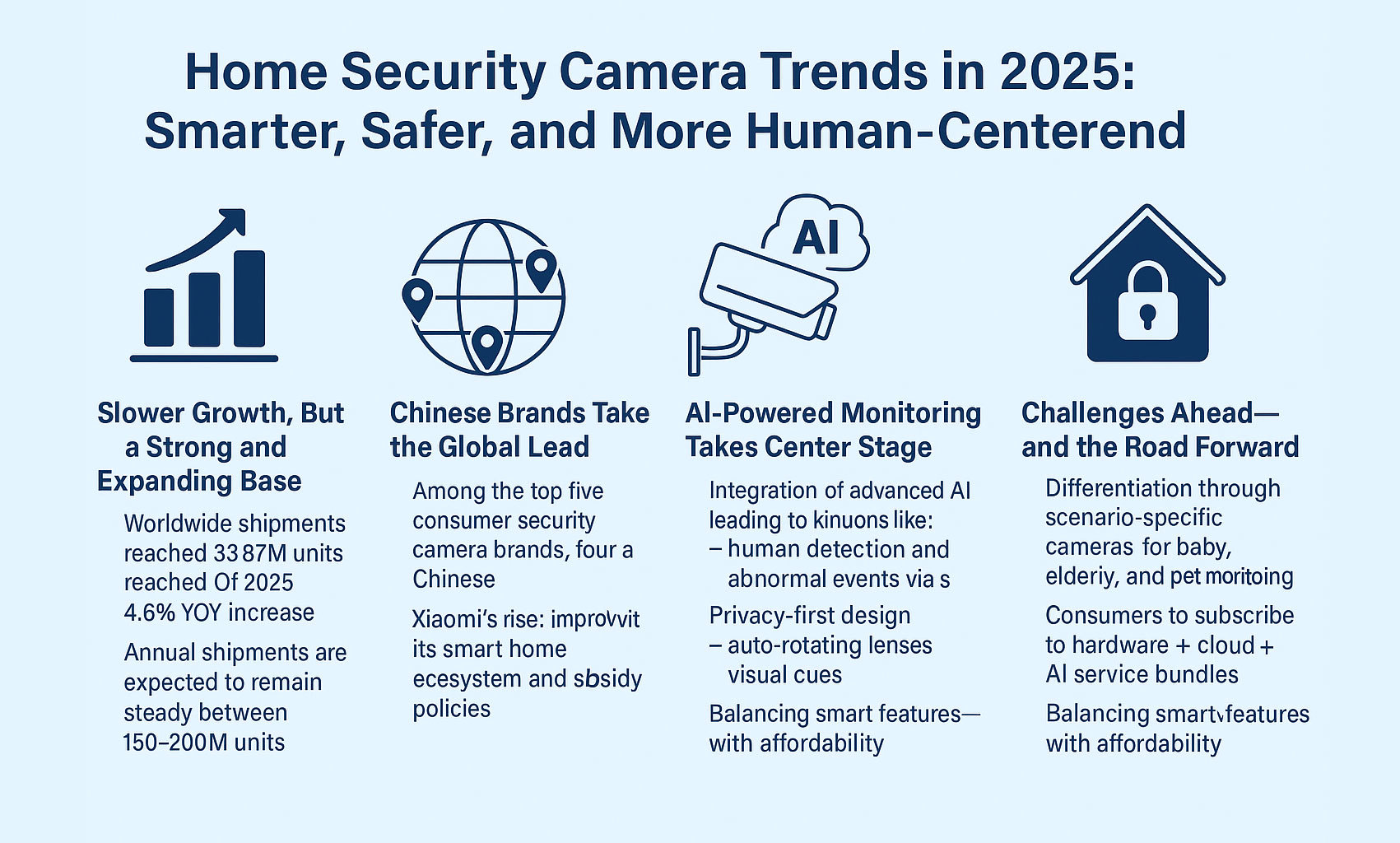
Smart Cameras Are No Longer Just Passive Eye — They See, Understand, Act
The real transformation in 2025 isn’t hardware — it’s intelligence. Modern cameras increasingly include:
AI-driven detection & analytics: including human / animal / vehicle detection, motion & behaviour recognition, and anomaly alerts.
Integration with smart home ecosystems and IoT: wireless HD cameras, Wi-Fi 6 connectivity, cloud storage, remote smartphone access — making cameras part of a broader smart-home setup.
Flexible power & installation: battery- or solar-powered cameras reduce installation friction and make it easier to place cameras in more locations.
These shifts reflect that homeowners increasingly view security cameras not just as surveillance tools, but as active, integrated parts of a smart home ecosystem — offering convenience, control, and real-time protection.
Privacy, Security Risks, and User Concerns
As cameras become smarter and more connected, legitimate concerns around privacy, data security, and regulatory compliance have grown:
A considerable portion of potential buyers cite data-privacy and cloud-security fears as reasons for either delaying or avoiding purchase.
Smart-home deployments linked to cloud services — while convenient — increase attack surfaces. Poor security practices (weak default passwords, unencrypted storage) can expose households to hacking or unauthorized access. This remains a key challenge for the industry.
As a response, there is rising demand for on-device processing, edge-AI, and solutions that minimize reliance on cloud storage — especially among privacy-conscious users.
What’s New/Next: Where the Market Is Heading
Based on current trends and industry forecasts, we expect several developments to shape the next few years:
Continued rise of wireless, solar & battery-powered cameras — making installation easier, expanding use to renters or people who move, as well as remote or off-grid locations.
More AI & edge-AI adoption — enabling offline or on-device motion / face / behavior detection to reduce cloud dependency and enhance privacy.
Smart-home ecosystem convergence — security cameras increasingly integrate with voice assistants, smart locks, sensors, home automation (lighting, climate, access control), making them just one part of a unified “smart home security system.”
Regulatory and privacy-driven product evolution — manufacturers will need to respond to privacy concerns and possibly stricter data-protection regulations (especially in regions like Europe), pushing for transparent data practices and optional local-only storage.
Market segmentation & specialization — rather than “one camera fits all,” we’ll likely see more niche devices: pet-cameras, baby monitors, elderly-care cameras (fall detection), solar-powered rural units, simple cloud-free cameras for privacy-prioritized users, etc.
Why the Original Article Likely Got Removed — What to Avoid When Re-Publishing
In my view, the original article from your site probably triggered removal because:
It presented unnamed “shipment” data (e.g., “33.87 million units shipped in Q1 2025” / “137 million units shipped in 2024”) with no verifiable source or attribution.
It made bold global-market claims — including brand-market-share rankings (“Chinese brands dominate, 4 of top 5…”), which aren't backed by publicly available, verifiable data in that format.
It lacked nuance: no discussion of privacy concerns, regional differences, or trade-offs. Rather, it painted a uniformly optimistic, sales-driven picture — which may run afoul of quality guidelines (overly promotional, lacking balanced reporting).
To get re-indexed and rank-well, an article should:
Cite reliable, publicly available data — from market reports, industry research, or peer-reviewed studies.
Provide balanced discussion — highlight both opportunities and risks / challenges (privacy, regulation, security risks).
Avoid vague, unverified global numbers — particularly when “sales units shipped” are claimed without citation — or else clearly attribute them to a named source.
Structure content in a digestible, professional format (headings, charts or bullet-data, referenced sources).
Suggested Revised Article — “Home Security Cameras in 2025: Trends, Data & What Comes Next”
Title: Home Security Cameras in 2025 — Growth, Innovation, and What’s Next
Introduction
The smart-home security camera market continues to grow in 2025, but the pace has slowed. Rather than explosive expansion, what we see now is maturation — rising adoption of smart, integrated, privacy-aware devices. This article reviews the latest data, major trends, challenges, and what the next few years may bring.Market Snapshot
Estimated global market size: ~ USD 8.9B in 2024, ~ USD 9.4B in 2025. Projected to reach ~ USD 15.4B by 2033.
Wireless and smart-enabled cameras now represent ~ 68% of consumer demand.
~ 53% of new devices integrate AI-driven cloud storage or video analytics.
Adoption of battery or solar-powered cameras growing (~ 36% increase), reflecting demand for flexible, easy-install options.
What’s Driving Demand
High smart-home penetration (especially in North America) and rising urbanization.
Growing interest in flexible installation (renters, multi-dwelling units, remote power).
Peace-of-mind use cases: monitoring children, pets, remote property, rather than solely crime deterrence.
Smart Features & Technology Trends
AI-based detection: human / animal / object recognition, motion & behavioral analytics.
Integration with IoT / smart-home ecosystems; widespread wireless, Wi-Fi 6 support; real-time remote monitoring.
Move toward more flexible power / installation: battery, solar, wireless — lowering barrier for renters and those without permanent wiring.
Challenges & Risks
Data privacy and cloud-security concerns remain a major barrier for many potential users.
Reliance on cloud services may increase exposure to hacking, unauthorized access, or data leaks. Intel Market Research
Regulatory and compliance pressures, especially in regions with strict data laws, may demand better transparency and optional local-only storage solutions.
Looking Ahead — What to Watch in 2025–2030
Continued momentum for wireless, battery/solar-powered cameras — for renters, flexible housing, and remote installations.
Rising adoption of edge-AI and on-device processing — enabling “smart cameras” that don’t need constant cloud connectivity.
Deeper smart-home ecosystem integration (voice assistants, smart locks, sensors), making cameras part of a broader home automation/security system.
More product differentiation — niche devices for pets, children, elderly care, rural homes, privacy-conscious users, etc.
Stronger emphasis on privacy, data security, and compliance — which could become a market differentiator rather than an afterthought.
Conclusion
The home security camera market in 2025 is no longer about flashy hardware or explosive growth. Instead, it’s evolving toward smart, integrated, flexible, and privacy-aware solutions — embedded in everyday life. For both manufacturers and homeowners, success will depend not just on “seeing” but on “understanding,” “integrating,” and “respecting” the home and its occupants.
Related News
Target readers: security owners, system integrators, and EHS engineers for petrochemical, oil and gas, pharmaceutical, powder processing, and coal mining sites where explosive gas or combustible dust exists. Core takeaway: a normal camera is itself an ignition source in flammable environments. You must use explosion proof cameras certified to ATEX, IECEx, or China Ex, selected by hazard zone, installed with proper grounding, and documented for compliance. This guide gives a reusable selection, install, and acceptance workflow.
Nov 08,2026
4G 5G Cellular Surveillance Camera Guide: Remote Video without Broadband
Target readers: security owners and integrators for farms, orchards, fisheries, construction, oil and mining sites, vehicle fleets, and remote African villages where broadband is scarce. Core takeaway: when there is no fiber, no broadband, and frequent power loss, a SIM card cellular camera is the easiest and most scalable remote video option. This guide gives a reusable architecture covering power, data, backhaul, AI, and compliant deployment.
Nov 08,2026
Analog CCTV Upgrade Guide: Coax HD Reuse vs Full IP Rebuild, Cost and Timeline Compared
Factory, campus and retail chains running analog surveillance for five or six years face the same wall: blurry images, unretrievable footage, and no path to AI analytics on legacy hardware. This guide breaks down pre-upgrade system inventory, compares the coax-HD reuse route against a full IP rebuild, gives bandwidth and storage recalculation formulas, and lays out a zoned, non-disruptive cutover plan with a selection checklist.
Oct 31,2026
CCTV Maintenance Outsourcing: SLA Tiers, Market Rates, KPI and Contract Playbook
Conclusion first: the real cost of a surveillance system is in its operation. Three years of maintenance typically equals 30% to 50% of the build cost, yet most buyers spend the budget at install and leave operation to whoever happens to notice. Lock the maintenance boundary while signing the build contract. This guide breaks down the in-house versus outsourced decision model, a three-tier SLA (P1 / P2 / P3), per-point market rates and how to read a quote, the two KPIs that decide payment (camera online rate and footage integrity), the five clauses every contract must hold, the 90-day handover that most often loses control, plus a selection checklist and acceptance tests.
Oct 25,2026
Links:One Belt Power Technology
Add: 14th Floor, Baoshan Building, Longhua District, Shenzhen China.
Privacy Policy | SEO | CitySite | Support: 300.cn Dongguan