














































































Why Construction Sites Need a 4G Solar Camera for Safety and Monitoring
Publish:
2025-09-23 19:49
Source:
https://www.ring-see.com
Discover how a 4G solar camera enhances safety and monitoring on construction sites. Learn the pros and cons of solar-powered surveillance, and see why trusted manufacturers like Ringsee are the go-to choice for contractors.
Every construction site tells a story of progress—steel beams rising, workers coordinating, and machines shaping the future. But behind the scenes, site managers face constant challenges: keeping workers safe, protecting expensive equipment, and ensuring projects move forward without delays.
Traditional wired security cameras don’t always fit into this dynamic environment. Many construction sites lack power or Wi-Fi, and installations are temporary by nature. That’s where a 4G solar camera steps in—a tool designed not just for surveillance, but for smarter, safer, and more efficient site management.
The Human Side of Safety
On a busy jobsite, even small oversights can lead to accidents. A 4G solar camera acts as a second set of eyes, capturing what managers can’t always see in real time. If a worker forgets to wear safety gear, if machinery is being operated incorrectly, or if an accident occurs, managers can intervene quickly.
Beyond prevention, video footage provides clarity. It helps resolve disputes, protect workers from false claims, and create a culture of accountability and care.
Protecting What Matters Most
Construction equipment and materials are valuable—and vulnerable. A stolen excavator or even just missing copper wiring can mean thousands of dollars in losses and project delays. With motion detection, night vision, and instant smartphone alerts, a solar-powered 4G camera deters intruders and helps security teams act before the damage is done.
Designed for the Realities of Construction
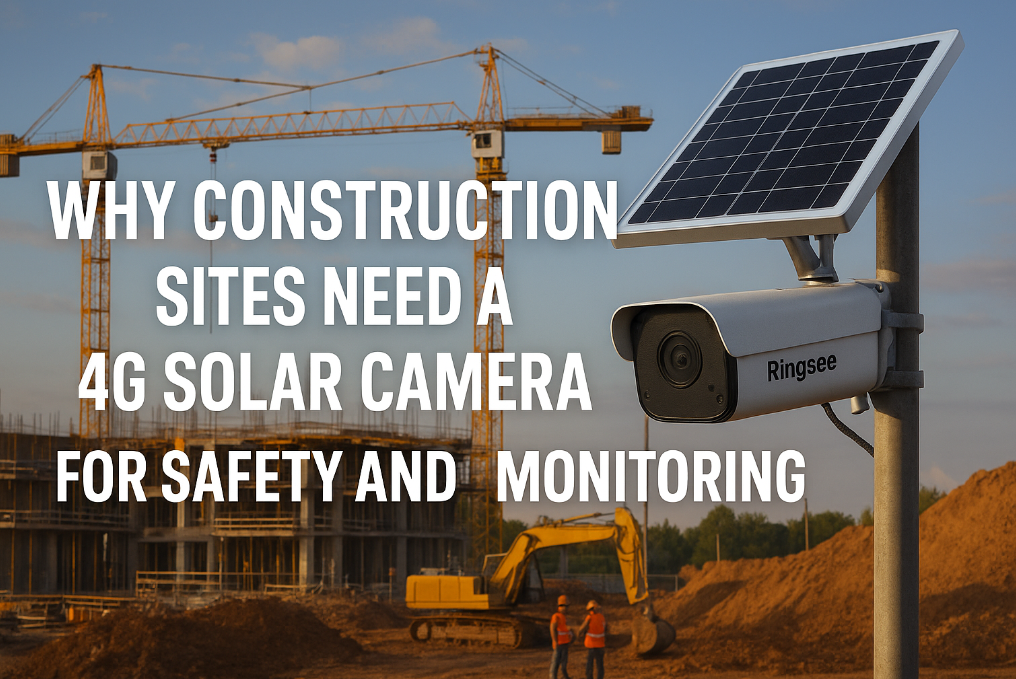
Unlike permanent wired systems, 4G solar cameras are portable and flexible. Need coverage on the north side this week and the east side next week? No problem—just relocate the unit. Powered by solar panels and connected via 4G, they keep running where electricity and internet can’t reach.
Advantages and Disadvantages of 4G Solar Cameras for Construction Sites
| Aspect | Advantages | Disadvantages |
|---|---|---|
| Power & Connectivity | Works off-grid with solar energy and 4G network—no need for wiring. | Dependent on good cellular coverage in remote areas. |
| Installation | Quick setup, easy to move as the project evolves. | Initial cost may be higher than basic wired cameras. |
| Safety Monitoring | Enables real-time worker monitoring and accident prevention. | Cannot replace in-person supervision entirely. |
| Security | Motion detection, night vision, and alerts reduce theft and vandalism. | May require cloud storage subscription for full functionality. |
| Cost Efficiency | Saves on generator fuel and wiring costs; eco-friendly with solar power. | Solar performance may be affected by poor weather or limited sunlight. |
| Remote Management | Managers can view live feeds from anywhere, improving decision-making. | Continuous video streaming may consume data quickly without proper planning. |
Partnering with the Right Manufacturer
Choosing the right device makes all the difference. Ringsee, a professional Chinese security camera manufacturer, specializes in OEM and ODM 4G solar cameras tailored for demanding environments like construction sites. With features like AI human detection, 2K resolution, and durable weatherproof housing, Ringsee cameras are built to meet real-world challenges while staying cost-effective for contractors.
Final Thoughts
A construction site is more than just a workplace—it’s a community, a project, and an investment. Protecting it requires more than fences and locks. A 4G solar camera provides peace of mind, ensuring safety for workers, protection for assets, and efficiency for managers.
By working with trusted manufacturers like Ringsee, construction companies can embrace technology that doesn’t just watch, but truly supports the progress happening on-site.
Related News
Target readers: security owners, system integrators, and EHS engineers for petrochemical, oil and gas, pharmaceutical, powder processing, and coal mining sites where explosive gas or combustible dust exists. Core takeaway: a normal camera is itself an ignition source in flammable environments. You must use explosion proof cameras certified to ATEX, IECEx, or China Ex, selected by hazard zone, installed with proper grounding, and documented for compliance. This guide gives a reusable selection, install, and acceptance workflow.
Nov 08,2026
4G 5G Cellular Surveillance Camera Guide: Remote Video without Broadband
Target readers: security owners and integrators for farms, orchards, fisheries, construction, oil and mining sites, vehicle fleets, and remote African villages where broadband is scarce. Core takeaway: when there is no fiber, no broadband, and frequent power loss, a SIM card cellular camera is the easiest and most scalable remote video option. This guide gives a reusable architecture covering power, data, backhaul, AI, and compliant deployment.
Nov 08,2026
Analog CCTV Upgrade Guide: Coax HD Reuse vs Full IP Rebuild, Cost and Timeline Compared
Factory, campus and retail chains running analog surveillance for five or six years face the same wall: blurry images, unretrievable footage, and no path to AI analytics on legacy hardware. This guide breaks down pre-upgrade system inventory, compares the coax-HD reuse route against a full IP rebuild, gives bandwidth and storage recalculation formulas, and lays out a zoned, non-disruptive cutover plan with a selection checklist.
Oct 31,2026
CCTV Maintenance Outsourcing: SLA Tiers, Market Rates, KPI and Contract Playbook
Conclusion first: the real cost of a surveillance system is in its operation. Three years of maintenance typically equals 30% to 50% of the build cost, yet most buyers spend the budget at install and leave operation to whoever happens to notice. Lock the maintenance boundary while signing the build contract. This guide breaks down the in-house versus outsourced decision model, a three-tier SLA (P1 / P2 / P3), per-point market rates and how to read a quote, the two KPIs that decide payment (camera online rate and footage integrity), the five clauses every contract must hold, the 90-day handover that most often loses control, plus a selection checklist and acceptance tests.
Oct 25,2026
Links:One Belt Power Technology
Add: 14th Floor, Baoshan Building, Longhua District, Shenzhen China.
Privacy Policy | SEO | CitySite | Support: 300.cn Dongguan